





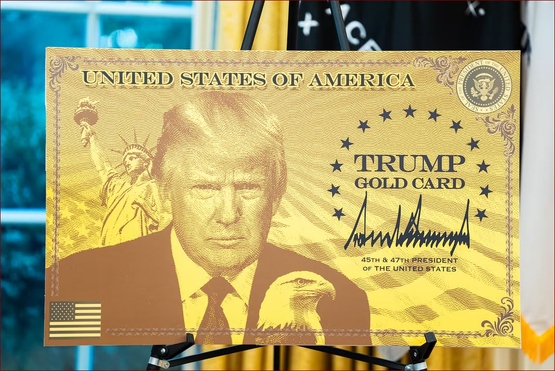
 A replica "Trump Gold Card" on display in the Oval Office. |
DONALD TRUMP'S obsession with putting his name and face on things long ago passed the point of parody. So far in his second term as president, Trump has moved to affix his name or picture to public buildings and government websites, to national park passes and a savings account for babies, and to a special $1 million visa, the so-called Trump Gold Card, for rich foreigners. The Treasury Department plans to mint a commemorative $1 coin depicting Trump next year. There is even a proposed "Trump class" of US Navy warships.
The president's "long love affair with his own name and likeness," as The New York Times recently described it, is certainly vulgar and narcissistic. But more than that, it is utterly at odds with the Republican presidential tradition. For most of the party's history, Republican chief executives generally refrained from personal self-glorification; many of them regarded it as a vice — something corrosive to judgment, dignity, and republican government itself.
In that sense, Trump's self-worship, besides being a severe character flaw, amounts to a repudiation of one of the most consistent and admirable moral instincts of GOP leadership.
It was an instinct memorably captured by Ronald Reagan, who displayed in the Oval Office a maxim that summed up an entire philosophy of leadership: "There is no limit to what a man can do or where he can go if he doesn't mind who gets the credit." Reagan, a one-time movie star, had nothing against publicity. He understood the interplay of politics, performance, and persuasion, but he believed ego was a liability in public office — and humility a governing strength.
This sensibility ran deep in Republican thought. Calvin Coolidge never hungered for applause. "It is difficult for men in high office to avoid the malady of self-delusion," he warned in 1929. Surrounded by flatterers and constantly assured of their own greatness, he wrote, they live in an "artificial atmosphere of adulation and exaltation" that eventually impairs their judgment.
Coolidge recognized that the presidency calls for modesty precisely because power breeds arrogance. Resisting the cult of self serves a double purpose: It checks personal excess and the temptations that corrode democratic governance.
None of this is to suggest these presidents were flawless or that all their policies were sound. It is simply to note that they shared a conviction that self-restraint in public life was a democratic necessity.
Many Republican presidents who exemplified that self-restraint had every excuse to do otherwise.
Ulysses Grant, the triumphant Civil War commander who became the second Republican president, harbored what contemporaries described as a lifelong aversion to boasting. Ron Chernow's sweeping 2017 biography of the 18th president opens with these words: "Even as other Civil War generals rushed to publish their memoirs, flaunting their conquests and cashing in on their celebrity, Ulysses S. Grant refused to trumpet his accomplishments in print." When, nearing death, he finally did write a book, he began by explaining that he had long resolved never to write for publication.
Or consider Abraham Lincoln, consistently ranked by historians as the greatest president in the nation's history. When an author sought permission to dedicate a book to him, Lincoln agreed only on the condition that the inscription be "in modest terms," not portraying him as a man of extraordinary learning or distinction. The leader who preserved the Union and destroyed slavery nonetheless recoiled from inflated self-regard.
That same instinct was still visible in the two most recent Republican presidents before Trump.
George W. Bush presided over one of the most consequential life-saving initiatives in American history, yet — tellingly — it was titled the President's Emergency Plan for AIDS Relief. Bush, who proposed PEPFAR in a moving passage of his 2003 State of the Union address, felt no compulsion to brand it with his own name. Even after leaving office, Bush resisted the temptation to burnish his own reputation by second-guessing his successor. "I have zero desire to be in the limelight," he said in 2010, explaining that silence from former presidents was healthier for the country than public score-settling.
His father embodied that ethos even more fully. George H. W. Bush, raised to shun what his mother called "the Great I Am," directed his speechwriters to avoid the word "I" in his public remarks. Even journalists sometimes marveled at the elder Bush's horror of seeming to praise himself. "He was the most modest person who ever held the office, at least in my lifetime," CBS newsman Bob Schieffer said in 2018.
Nearly every Republican president from Lincoln onward would have recoiled from Trump's bottomless narcissism. In this crucial respect, as in so many others, today's Republican president stands not in continuity with his party's history, but as its very antithesis.
Jeff Jacoby is a columnist for The Boston Globe.
-- ## --
Follow Jeff Jacoby on X.
Discuss his columns on Facebook.
Want to read something different? Sign up for "Arguable," Jeff Jacoby's free weekly newsletter.