






THE SUPREME Court will hear oral arguments next week in Trump v. Barbara, in what is expected to be a landmark showdown on the president's campaign to abolish birthright citizenship. The rule that virtually anyone born on US soil is automatically a US citizen — a guarantee rooted in American common law and enshrined in the Fourteenth Amendment — has been regarded as settled for generations. But President Trump, an implacable enemy of birthright citizenship, signed an executive order last year intended to force a confrontation on the issue. Within hours of being sworn in for a second term as president, he directed all agencies of the federal government to refuse to recognize children born in America as citizens if neither of their parents was a US citizen or a permanent legal resident.
It is hard to overstate just how radical Trump's position is.
When US District Judge John Coughenour issued a ruling blocking Trump's "blatantly unconstitutional" order from taking effect, he stressed that it wasn't a close call. "I've been on the bench for four decades," said the judge, who was appointed by President Reagan in 1981. "I can't remember another case where the question presented is as clear as this one." That judgment has so far been confirmed by every federal district and circuit court that has weighed in on the case.
But set aside the legal argument for the moment. To appreciate how far the administration has ventured beyond any recognizable American tradition, consider instead an argument from history: Not even America's most ferociously anti-immigrant movement ever challenged the legitimacy of birthright citizenship.
That arresting point is developed by three well-known legal historians — Tyler Anbinder of George Washington University, Garrett Epps of the University of Baltimore, and Aviam Soifer of the University of Hawaii — in a friend-of-the-court brief filed last month.
"If any political party in this country's history were to have proposed the position the [Trump administration] now advocates before this court, it would have been the Know Nothings," their brief begins. "They did not."
The Know Nothing movement of the mid-19th century was the most successful and the most extreme anti-immigrant crusade in American history. A rising tide of Irish and Catholic immigrants from Europe in the 1840s had ignited a backlash of nativist fear and bigotry, which the Know Nothings exploited for political gain. (Originally organized as a secret society, its members were required to answer questions about their activities by saying "I know nothing" — which inspired the nickname that stuck long after the secrecy had been abandoned.)
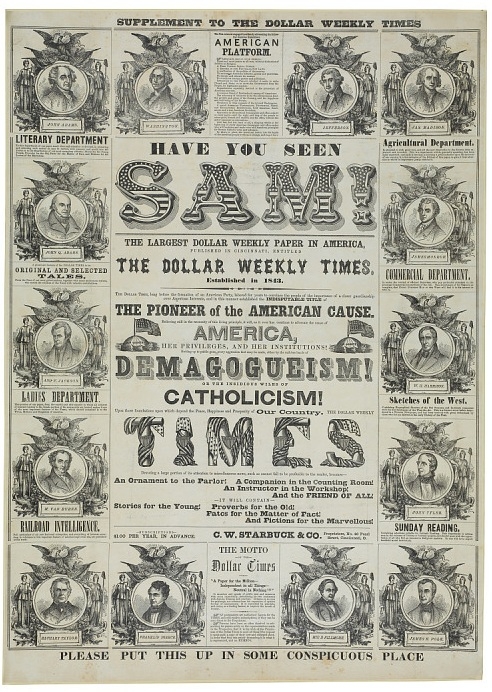 The anti-immigrant Know Nothings have faded from public memory, but they were once a seemingly unstoppable political force. Above: a Know Nothing poster from 1854. |
Today the Know Nothings are scarcely remembered, but at one time their appeal to voters was a mighty political force. Beginning in the 1850s, they won sweeping victories in multiple state legislatures; elected governors in Delaware, Maryland, Kentucky, and California; and swept every congressional race in Connecticut, Rhode Island, and New Hampshire. But it was in Massachusetts that their power was greatest. In 1854, Know Nothing candidates won every statewide office, more than 99 percent of the state Legislature, the entire congressional delegation. They also took control of city governments, electing mayors in Boston, Worcester, Fall River, and Salem. It was the greatest electoral landslide in Massachusetts history.
At the national level, meanwhile, when the Thirty-Fourth Congress convened in December 1855, roughly half its members had ties to the Know Nothing movement, which by then had rebranded itself the American Party.
Empowered by such sweeping victories, the nativists moved aggressively to enact numerous legal restrictions on immigrants, especially those who were Catholic. Persuaded that Catholic immigrants could never shed their primary allegiance to the Pope, and that the Irish in particular were congenitally resistant to assimilation — the Irish "banded together," the Know Nothings insisted, "specifically to resist assimilation" — they sought to quadruple the waiting period before immigrants could become citizens and barred the foreign-born from holding public office. In Massachusetts, lawmakers prohibited the teaching of foreign languages in public schools and mandated state inspections of convents.
"Massachusetts even went so far as to deport several thousand Irish immigrants who had fled the Great Potato Famine," Anbinder, Epps, and Soifer recount in their brief, on the grounds that "they remained indigent and therefore would become public charges."
Like the Trump administration today, the Know Nothings argued that their anti-immigration agenda was necessary to protect the country from an influx of foreigners who were incapable of becoming loyal Americans. An editorial in one Know Nothing newspaper, for example, contended that new immigrants were "determined that neither themselves nor their children shall ever conform to American manners, American sentiments, or the Spirit of American Institutions." Another publication cast the threat posed by Irish and German newcomers in apocalyptic terms: "A portentous cloud seems to be rising in the East. As it gradually approaches ... it becomes darker; its thunders begin already to roar and its lightnings to flash, and it is feared that a tempest of inconceivable terror will soon be upon us, and demolish our glorious temple of freedom."
Yet even at the height of their power, and notwithstanding their belief that the immigrants surging into the United States were undermining the cohesion of American society, one thing the Know Nothings never challenged was the settled rule that children born on US soil were automatically US citizens.
A review of Know Nothing policy platforms in every state, the Anbinder/Epps/Soifer brief reports, "shows that the organization never pursued any limitations on birthright citizenship." Even the American-born children of the deported Irish paupers from Massachusetts were recognized as citizens. The right of citizenship by birth was inviolable even to those who went out of their way to make life as difficult as possible for disfavored immigrants — and who sincerely believed those immigrants would never truly fit into American society.
The same point emerges, even more starkly, from a still darker chapter in American history. In California during World War II, the Native Sons of the Golden West — a white-supremacist organization intent on excluding Asian and Mexican immigrants — mounted a legal campaign to strip Japanese Americans born in the United States of their citizenship. The group's effort, led by former California attorney general Ulysses Webb, unfolded amid the federal government's mass incarceration of 120,000 people of Japanese ancestry and at a time when federal law categorically barred Asian immigrants from acquiring US citizenship. If there was ever a moment when an attack on birthright citizenship might find a receptive audience, that was it.
It didn't.
As University of California Berkeley law professor Amanda Tyler documents in her own friend-of-the-court brief in Trump v. Barbara, not a single senior government official questioned the citizenship of Japanese Americans born on US soil — not Attorney General Francis Biddle, not Secretary of War Henry Stimson, not even General John DeWitt, who had overseen the mass internment of Japanese Americans. "An American citizen, after all, is an American citizen," DeWitt acknowledged.
The lawsuit filed by the West Coast nativists, Regan v. King, went nowhere. After being dismissed by the federal district court in San Francisco, it was appealed to the US Ninth Circuit Court of Appeals, which summarily sustained the district court's decision. The Supreme Court declined to take the case. The Native Sons' attempt to denationalize Japanese Americans was an ignominious failure — and the organization has spent decades since trying to live down its racist history.
The Trump administration is now asking the Supreme Court to accomplish what the Know Nothings and the Native Sons, for all their malice and all their power, never could. Yale constitutional scholar Akhil Reed Amar — who laid out the case against the executive order in a New York Times essay last month (as well as in his own amicus brief in the current case) — warns that a ruling upholding the president's executive order "would be eerily reminiscent of Dred Scott v. Sandford," the 1857 ruling that denied citizenship to Black Americans and is widely considered the worst decision in Supreme Court history.
What is at stake, in the end, is not a legal abstraction but a question about babies born in American hospitals, on American soil, under the American flag: whether they are Americans. Every court that has faced that question has answered yes. Every nativist movement that challenged that answer lost. The answer hasn't changed. When the Supreme Court says so, its decision should be unanimous.
* * * * * * * * * * * * * * * * * * * * * * * * * * * * * * * * * * * * * * * * * * * * * * *
What I Wrote Then
24 years ago on the op-ed page
From "The US embargo and Cuba's future," March 21, 2002:
So long as Cuba's dictator maintains his stranglehold on every aspect of Cuban life, ending the embargo would be counterproductive. It would do nothing to end the far more restrictive embargo that Castro imposes on the Cuban nation. It would give him the propaganda victory and the US dollars he craves, but it would do little to bring liberty or hope to ordinary Cuban citizens.
Every president since JFK has extended the Cuban embargo; to lift it in exchange for nothing -- no free elections, no civil liberties, no improvement in human rights -- would be a betrayal of the very people we want to help. "Tiende tu mano a Cuba," says Paya when I ask what he thinks of American policy, "pero primero pide que le desaten las manos a los cubanos." Extend your hands to Cuba -- but first unshackle ours.
* * * * * * * * * * * * * * * * * * * * * * * * * * * * * * * * * * * * * * * * * * * * * *
The Last Line
"If in the first attempt to create a world of free men we have failed, we must try again. The guiding principle that a policy of freedom for the individual is the only truly progressive policy remains as true today as it was in the nineteenth century." — Friedrich Hayek, The Road to Serfdom (1944)
* * * * * * * * * * * * * * * * * * * * * * * * * * * * * * * * * * * * * * * * * * * * * *
Jeff Jacoby is a columnist for The Boston Globe.
-- ## --
Follow Jeff Jacoby on X (aka Twitter).
Discuss his columns on Facebook.
Want to read something different? Sign up for "Arguable," Jeff Jacoby's free weekly newsletter.