






WHEN OSAMA bin Laden, the Al Qaeda leader who organized the murder of thousands of innocent victims on 9/11, was killed by SEAL Team Six at his hideout in Pakistan in 2011, throngs of Americans spontaneously poured into the streets to celebrate his death. In an exultant editorial headlined "Justice!", the New York Post spoke for many: "The son of a bitch is dead. Ding dong."
Satisfaction, even joy, is the appropriate reaction when a mass murderer or vicious terrorist is terminated with extreme prejudice. In October 2019, the US military operation that culminated in the killing of Abu Bakr al-Baghdadi — the self-proclaimed caliph of the savage Islamic State — elicited a wave of congratulations from America's global allies. More than a decade earlier, The New York Times reveled in the successful elimination of a key Bin Laden henchman:
"It is good news for Washington, and even better news for Iraq, that the Jordanian terrorist Abu Musab al-Zarqawi was finally killed on Wednesday by an American airstrike," the Times editorialized at the time. "The group that Mr. Zarqawi led, Al Qaeda in Mesopotamia, organized and carried out some of the most beastly bombings and beheadings of recent years. ... Zarqawi played a substantial role in spreading terror and mayhem across Iraq."
So for anyone with a functioning moral compass, it was doubly satisfying when Israel last week abruptly ended the careers of two terrorist masterminds within a 24-hour span.
On Tuesday, a pinpoint strike on a suburb of Beirut, Lebanon, took out Fuad Shukr, the senior Hezbollah commander responsible for the rocket campaign against northern Israel that slaughtered 12 children playing soccer in the town of Majdal Shams. Decades earlier, Shukr had played a key role in the 1983 killing of 241 American servicemen in Beirut; the State Department had put a $5 million bounty on his head.
On Wednesday, an explosion in a Tehran guesthouse killed Ismail Haniyeh, Hamas's highest ranking political official. Israel has neither confirmed nor denied that it was involved in the assassination. But so brilliantly was it executed — the bomb that dispatched Haniyeh had been smuggled into the guest quarters months earlier and its detonation was both a humiliation and a warning to the Iranian regime that was hosting him — that no one doubts it was an Israeli operation.
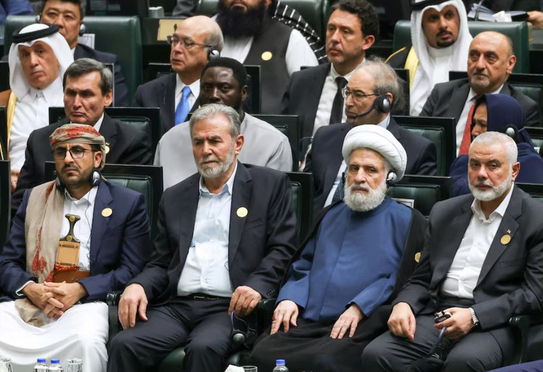 Hamas's top leader Ismail Haniyeh (front row, right) attended the swearing-in of Iran's new president in Tehran on July 30. A few hours later, he was killed by a bomb in his guesthouse. |
"Good riddance. ... [C]elebrate the death of another terrorist." was National Review's sensible reaction. The New York Sun observed with approval that the Haniyeh execution was "a moment to mark" and that its message was unambiguous: "Israel has lost none of its righteous resolve."
To the Israel-haters, of course, the eradication of two arch-terrorists was just another reason to revile the Jewish state. In Times Square, hundreds of protesters rallied to chant "Free Palestine" while waving Hamas and Hezbollah flags and hoisting photos of Haniyeh. The Turkish government, in a calculated insult, directed its embassy in Israel to lower its flag to half-mast as a sign of mourning for the slain Hamas leader. In Qatar, the duplicitous Persian Gulf sheikhdom that for years has underwritten Hamas's control of Gaza while claiming to be a US ally, a giant image of Haniyeh was projected onto an office tower in Doha.
But even some friends of Israel, while relieved that Shukr and Haniyeh would no longer be able to shed innocent blood, were uncomfortable with the idea of actively expressing joy at their demise.
"Hate Ismail Haniyeh, but don't celebrate his death," a column in The Jerusalem Post by American rabbi and media personality Shmuley Boteach was headlined. Quoting the admonition of the biblical book of Proverbs — "Do not rejoice when your enemy falls" (24:17) — Boteach insisted that while there should be no elation over the killing of Haniyeh, it is appropriate to feel "thanks and gratitude to God that evil has been rooted out." Luke Moon, a Baptist minister who heads the Philos Project, asked in an email: "How should Christians react to the death of an evil man?" He cited a different — a very different — verse from Proverbs: "When the wicked perish, there is jubilation" (11:10). There is "a recognition," Moon remarked, "that the death of an evil man benefits society."
I don't propose to get into a theological dispute with either the rabbi or the minister, but I would suggest that there is a difference between the fall of an enemy who bears you no particular malice but is simply caught up in larger events — think of ordinary enlisted soldiers opposing each other on a battlefield — and the downfall of a monster consumed with homicidal hatred for you and all your loved ones. There is also a fundamental difference between an "enemy" who is nonviolent — a fierce business rival, a passionate political opponent — and a genocidal killer whose overriding goal is to kill and terrorize innocent victims.
Death is unavoidable in combat. Even the most decent societies cannot avoid taking lives — sometimes many, many lives — in the course of waging a just war. Ordinarily, the only appropriate reaction to such killing is regret that it was necessary and sorrow at the unavoidable loss of life. But the situation is altered when a profoundly brutal and sadistic villain, one who revels in the torture and murder of others, is eliminated. The assassination of the Hezbollah and Hamas terror chieftains — men of unspeakable cruelty who devoted their lives to spreading terror, pain, and destruction — made the world a better and safer place. To be happy at such a moment is no moral failing.
America's friends had every right to feel euphoric when SEAL Team Six brought justice to Bin Laden. Israel's friends should be no less joyful now that Shukr and Haniyeh have joined him in hell.
* * * * * * * * * * * * * * * * * * * * * * * * * * * * * * * * * * * * * * * * * * * * * *
Congress waves the protectionist flag
Senator Sherrod Brown took a victory lap last week when President Biden signed the All-American Flag Act that the Ohio Democrat first introduced in 2011. The new law requires that American flags purchased by the American government must be "100 percent manufactured in the United States from articles, materials, or supplies that have been grown or 100 percent produced or manufactured in the United States."
This is unfiltered protectionism at its most jingoistic, and Brown couldn't be more pleased.
"American flags – bought with American taxpayer dollars – should be made in America, period. And now they will be," he declared in a statement. "American flags bought by the federal government will be produced and manufactured in America, by American workers with American materials. The flags that fly over federal buildings and military bases will now be completely American made. And the flags given to families honoring their loved one's service and sacrifice for our country will finally be completely made in America."
Such sentiments have a potent appeal — so potent, in fact, that Brown's legislation passed unanimously in both the House and Senate. But Brown is wrong and the new law is unfortunate.
When it comes to the Stars and Stripes, emotion has a way of overriding logic and first principles. Americans who love the flag and the Republic for which it stands may feel that, given its extraordinary power as a symbol of the nation, it shouldn't be bound by ordinary considerations. But that attitude doesn't stand up to even mild scrutiny. The passions evoked by the flag are not affected by where it was manufactured. The meaning of the flag draped over a casket or hoisted above City Hall is the same whether that flag was stitched in Canada or China or Cincinnati. It makes no more sense to insist that American flags must be made in America by American workers than to insist that Ohio flags must be made in Ohio by Ohio workers. Or, for that matter, to insist that because Shakespeare was English, his plays must be confined to books printed in England on paper from English mills.
Brown's law has nothing to do with respect for the flag. It has everything to do with pandering to US businesses that resent competition. Such pandering is not smart public policy. Nor is it patriotic.
US flags should be made anywhere and by anyone who can do so profitably. And the federal government should buy its flags — and all other goods and services, except for those with sensitive national security implications — from the supplier who offers the best value. When public officials spend taxpayers' money, their first responsibility is not to strike a red-white-and-blue pose. It is to get the highest available quality at the lowest available terms. If Canadian firms can supply well-made US flags for less than a firm in Arkansas or Pennsylvania can, they should get the contract. Refusing to buy from them cheats US taxpayers.
Of course this applies only in the public sector. Private individuals and organizations spending their own money have every right to buy only made-in-America flags — or, for that matter, made-in-America screwdrivers, tennis rackets, and hot sauce. But the government never spends its own money. It spends your money and mine. And when politicians skew the rules to ensure that our money is spent to benefit a few favored domestic producers, they are robbing all of us Peters in order to enrich a handful of Pauls.
 The Stars and Stripes at the US Capitol |
"Buy American" restrictions are self-inflicted wounds, not indications of devotion. And they are absurd: It is as daft to force American consumers and manufacturers to confine their economic activity to American soil as it would be for residents of a state to be compelled to confine their spending to their own state. When people in Massachusetts do business with people in New Hampshire or New York or New Mexico, it isn't evidence of the Bay Staters' disloyalty or weak self-esteem. Everyone understands that Americans trade across state borders because doing so increases economic opportunity and improves our standard of living. Prosperity doesn't come from confining trade behind boundaries but from expanding it beyond those boundaries. That's true of neighborhoods, cities, and states. It's no less true of countries.
Those entrusted with taxpayer dollars should be required not to buy American but to buy wisely: to get good quality at a good price. When American-sourced products — be they flags, washing machines, microchips, or jet engines — meet that standard, by all means buy them. When imports are available at higher quality and lower cost, buy them. Protectionism is bad for America. Wrapping it in the Stars and Stripes doesn't make it better.
+++++++++++++++++++++++++++++++++++++++++++++++++++++++++++
When the 'settled science' was wrong about ulcers
It wasn't that long ago that medical science was clear that ulcers were the result of stress or diet — a chronic condition exacerbated by eating spicy foods or consuming alcohol. A handful of researchers, like Australian pathologist Robin Warren and his gastroenterologist colleague Barry Marshall, contended that the settled science was wrong and that ulcers were actually types of infection caused by bacteria. But their refusal to accept the overwhelming scientific consensus was dismissed out of hand. When Marshall submitted a paper to the Gastroenterological Society of Australia that linked peptic ulcers to the bacterium H. pylori, it was tersely rejected.
"To gastroenterologists," Marshall later remarked, "the concept of a germ causing ulcers was like saying that the Earth is flat."
Warren had similar experiences. "For about 100 years, or 1,000 years, the standard teaching in medicine was that the stomach was sterile and nothing grew there because of corrosive gastric juices," Warren told a reporter. "So everybody believed there were no bacteria in the stomach. When I said they were there, no one believed it." On one occasion, a paper submitted by Warren and Marshall was not only spurned out of hand, they were told by the judges that it was "shameful" to produce such research.
But Warren and Marshall were right. The settled science — and the scientists who treated them as pariahs for their nonconventional view — were wrong. In 2005, the Australian duo shared the Nobel prize in medicine for their "remarkable and unexpected discovery" that the H. pylori bacterium is the origin of ulcers.
Warren, the older of the two men, died recently in Perth at 87. His career is a reminder that a thing isn't necessarily true or false just because scientists say it is. Science is no more immune to misjudgments, stubbornness, or resistance to idiosyncratic opinions than any other area of human inquiry. From the geocentric model in astronomy to the "scientific racism" of eugenics to mandating 6-foot social distancing during the COVID pandemic, many is the scientific consensus that has been upended by new knowledge and persistent dissenters.
In a 1955 lecture at the National Academy of Sciences, the great physicist Richard Feynman warned against dogmatism in science and decried the urge to stifle skepticism, even about matters that are supposedly settled:
If we suppress all discussion, all criticism, proclaiming "This is the answer, my friends; man is saved!" we will doom humanity for a long time to the chains of authority, confined to the limits of our present imagination. It has been done so many times before.
It is our responsibility as scientists . . . [to uphold] freedom of thought, to proclaim the value of this freedom; to teach how doubt is not to be feared but welcomed and discussed; and to demand this freedom as our duty to all coming generations.
+++++++++++++++++++++++++++++++++++++++++++++++++++++++++++
What I Wrote Then
25 years ago on the op-ed page
From "The absurdity of Census Question No. 6," Aug. 12, 1999:
Nowhere is it decreed that governments must classify their citizens by race. We are asked about our ancestry; that is enough. The race question serves only to divide Americans and to strengthen those who feed on racial division.
The difference between ancestry and race is that one is real and one is largely fiction. Race is a social construct, not a biological fact. The genes of whites, Blacks, and "native Hawaiians" are indistinguishable. Of course there are physical variations among populations that originated at points far apart on the globe. But the idea that those variations are racial is a relatively recent one.
* * * * * * * * * * * * * * * * * * * * * * * * * * * * * * * * * * * * * * * * * * * * * *
The Last Line
" 'My, my. A body does get around. Here we aint been coming from Alabama but two months, and now it's already Tennessee.' " — William Faulkner, Light in August (1932)
* * * * * * * * * * * * * * * * * * * * * * * * * * * * * * * * * * * * * * * * * * * * * *
Jeff Jacoby is a columnist for The Boston Globe.
-- ## --
Follow Jeff Jacoby on X .
Discuss his columns on Facebook.
Want to read something different? Sign up for "Arguable," Jeff Jacoby's free weekly newsletter.