





I first encountered Dennis Prager's ideas on ethics, religion, and current events in the late 1980s, when I subscribed to his quarterly newsletter "Ultimate Issues." In the years that followed, I read many of Prager's commentaries and listened to some of his speeches. When his syndicated talk show was on Boston radio, I tuned in when I could. I bought several of his books, one of which I kept in my office at the Globe: his 1995 essay collection, "Think a Second Time."
On more than one occasion I quoted Prager's words and ideas in my column, including his insight that gratitude is the secret to happiness and his insistence that goodness and personal decency are indispensable to a healthy society. Now and then, Prager quoted me as well. The 2003 edition of "Why the Jews?", a study of antisemitism he co-authored with Joseph Telushkin, opens with a 2 ½-page excerpt from a column I wrote about surging anti-Jewish bigotry in Europe.
So when Prager became an unabashed defender of Donald Trump in 2016 — and charged me with promoting "gratuitous hatred" for deploring the hypocrisy of religious conservatives who condemned Bill Clinton's moral corruption but excused Trump's — my disappointment was personal as well as intellectual. Here was a man who had spent decades championing integrity and warning that the worship of "false gods" could lead good people to defend the indefensible. I was dismayed that Prager, who had once said that Trump's unabashed crudeness made him "unfit to be a presidential candidate, let alone president," had embraced the MAGA view that it was absurd to oppose a candidate merely because of his personal behavior.
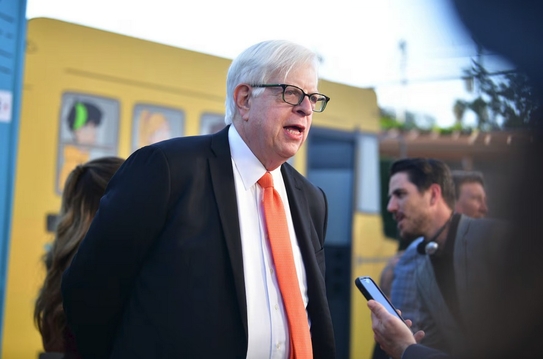 Before the fall: Dennis Prager at a TV premiere in 2024. |
Later came Prager's lawsuit against YouTube, which had enabled his PragerU videos to be viewed more than a billion times a year at no charge. Not only did Prager take YouTube to court over a trivial content filter, he publicly lambasted the company and implied that it was engaging in Nazi-like repression. As a legal matter, Prager's suit was meritless. As an ethical matter, I wrote, it was an egregious betrayal of his own gratitude principle.
But convictions can be tested in very different ways. A person who fails one kind of test can face a far harder one. Prager's capitulation on Trump, like that of so many other prominent conservatives, came when his principles collided with his professional interest in maintaining his influence, his audience, and his relevance. That is a genuine test, but it is not the only kind. Far more difficult is when your beliefs are not challenged by the world outside but by catastrophe visited upon your own body and life.
Which is precisely what happened in November 2024, when Prager fell at home — a devastating accident that injured his spinal cord, leaving him paralyzed from the shoulders down. So severe was the damage that his doctors did not expect him to survive. They advised his family to commence palliative care in order to make his last days as pain-free as possible.
But Prager did survive, and last week he described his experience in a column for The Wall Street Journal, headlined "Mostly Paralyzed but Happy to Be Alive." It is an extraordinary essay — not because of its personal drama, but because of its clarity. Prager is bedridden and expects to be so for the rest of his days. The active life he cherished — which included lecturing all over the world, broadcasting a daily radio show, leading an annual listener cruise, and even conducting symphony orchestras — has been taken from him. Not surprisingly, he has replayed in his mind over and over the fall that transformed his world.
"From the day I regained consciousness," Prager wrote, "I realized I had only three alternatives: death, depression, or perseverance." Since he doesn't want to die and doesn't want to be depressed, his choice, he concluded, was obvious.
What makes this more than just an affecting personal essay is the philosophy behind it. For decades Prager taught that happiness is not something that happens but something that must be pursued, and that the key to that pursuit is gratitude. He was influenced in this by Viktor Frankl, the renowned psychiatrist and Holocaust survivor who wrote "Man's Search for Meaning." Frankl's book contended that while human beings may not be able to avoid suffering, they always retain the freedom to choose their response to it. The less you take for granted, Prager argued, the more reasons you will find to be thankful. And the more thankful you are, the happier you can be — even in dire circumstances. It was a view Prager expressed in books, lectures, and broadcasts when he enjoyed good health and vigor.
Now he expresses it from a hospital bed, with his body permanently broken but his mind intact.
Prager has not stopped counting his blessings. He is thankful that his wife happened to be nearby when he fell, that he retains his mental faculties and his ability to speak, that he is surrounded and supported by family and friends. He finds in these things not consolation prizes but genuine causes for gratitude. His philosophy, it turns out, was not merely something he believed in the abstract. It was something he had actually prepared himself to live.
What Prager has done — or rather, what he has refused to do — strikes me as genuinely heroic. It would have been entirely understandable for a man in his condition to be consumed by anger and self-pity. No one would have blamed him. Instead, he has chosen — and it is a choice, made deliberately, every day — to find reasons for gratitude and pursue happiness despite all he has lost.
 There is heroism in refusing, in the face of irreversible loss, to be defeated from within. |
There is something almost paradoxical about describing a paralyzed and bedridden man's cheerfulness as heroic. But perhaps that is exactly what it is — not the heroism of action, but the rarer kind: the refusal, in the face of irreversible loss, to be defeated from within. Prager has spent his career insisting that ideas have consequences — that what people actually believe about happiness and gratitude will show up in how they live. He was right. It just took a catastrophe to prove it.
* * * * * * * * * * * * * * * * * * * * * * * * * * * * * * * * * * * * * * * * * * * * * * *
What I Wrote Then
24 years ago on the op-ed page
From "Swift shows true grit when it comes to taxes" Feb. 28, 2002
Jane Swift is defending the tax cut despite the opposition of the state's most powerful legislators. Despite the opposition of the state's biggest newspaper. Despite the opposition of some, maybe most, of the state's corporate big shots....
Swift has her faults — just ask the Republicans who are trying to draft Mitt Romney — but taking the easy way out when it comes to tax policy is not among them. If she were to break her no-new-taxes promise, Beacon Hill would cheer, the Globe's editorial page would applaud, and the state's big-business chieftains would smile with approval. Instead, she is sticking to her pledge. Whatever else might be said of her, she's got backbone.
* * * * * * * * * * * * * * * * * * * * * * * * * * * * * * * * * * * * * * * * * * * * * * *
The Last Line
"Each morning with the rising of the routine sun as I wake up and put on my veil before the mirror to go out and become a part of what is called reality, I also know of another 'I' that has become naked on the pages of a book: in a fictional world, I have become fixed like a Rodin statue. And so I will remain as long as you keep me in your eyes, dear readers." — Azar Nafisi, Reading Lolita in Tehran (2003)
* * * * * * * * * * * * * * * * * * * * * * * * * * * * * * * * * * * * * * * * * * * * * * *
Jeff Jacoby is a columnist for The Boston Globe.
-- ## --
Follow Jeff Jacoby on X (aka Twitter).
Discuss his columns on Facebook.
Want to read something different? Sign up for "Arguable," Jeff Jacoby's free weekly newsletter.