





What a naive assumption.
As I now know from reading "An Ordinary Man," Richard Norton Smith's superb 2023 biography of the far-from-ordinary Ford, there was fierce resistance to providing refuge to Vietnam's frantic boat people.
On May 1, 1975, just days after Saigon fell, the House of Representatives voted down $327 million in emergency funding to evacuate and resettle some 70,000 South Vietnamese refugees. The president erupted when he saw the news: "Those sons of bitches," he said, shocking his press secretary, Ron Nessen, who had never before heard Ford curse.
The opposition wasn't marginal. Robert Byrd of West Virginia, the Senate majority whip, said there was "no political support" for admitting the refugees, whose ranks, he claimed, included "undesirables," such as "barmaids, prostitutes, and criminals." Senator George McGovern declared flatly: "The Vietnamese are better off in Vietnam." In a Gallup poll, 54 percent of respondents agreed. Outside Fort Chaffee, Ark., where some refugees were being housed, one protester expressed the hope that "with a little luck, maybe they'll take pneumonia and die."
Ford pressed ahead anyway. He urged Congress to uphold the nation's "long tradition of opening its doors to immigrants" fleeing tyranny. America had welcomed Hungarian and Cuban refugees escaping Communism and "they've been good citizens," he said. "We ought to welcome these people the same way."
That history takes on an unmistakable resonance today, amid the Trump administration's ruthless campaign to deport undocumented migrants and sharply curtail refugee admissions.
Especially striking half a century later is how much of the hostility toward South Vietnam's displaced families came from the political left.
The episode underscores something Americans often forget. Nativism and xenophobia surge in times of economic anxiety or cultural unease, and though the targets may change, the arguments against all of them tend to be all too familiar: They steal jobs. They drive down wages. They commit crimes. They don't assimilate. They abuse the welfare system. They don't share our values. Sadly, the impulse to pull up the gangplank and keep migrants out has been a bipartisan and deeply rooted reflex.
The Vietnamese episode was hardly unique. When refugees arrive at our gate, compassion often yields to fear — and not only on the right.
In the 1930s, as Jews desperately sought to get out of Nazi Germany, the administration of Franklin D. Roosevelt worked assiduously to ensure they didn't come to the United States. The White House balked at a proposal to admit 20,000 child refugees. It likewise refused to help the 937 refugees aboard the German ocean liner St. Louis, who reached the coast of Florida in May 1939, only to be denied entry and forced back to Europe, where hundreds of them perished in the Holocaust. That egregious moral failure was not Democratic or Republican. It was American.
Six decades later, it was President Bill Clinton who slammed the door on Haitians fleeing violence and repression. In one of my earliest Globe columns, headlined "Let the Haitians in," I argued that they were precisely the kind of newcomers America should crave: men and women prepared to risk everything, even their lives, for a chance at freedom and its opportunities.
Even icons of progressive politics have succumbed to the same reflex. Long before Donald Trump and his MAGA followers directed vitriol at undocumented migrants, Cesar Chavez and the United Farm Workers opposed illegal immigration, dispatching hundreds of union members to report border crossers to federal authorities and arguing that migrant labor caused widespread unemployment among American workers.
None of this makes today's nativist demagoguery less odious. Rather, it reminds us that antipathy toward foreigners has come in every partisan shade.
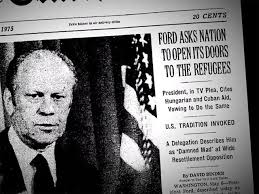 The opposition to admitting South Vietnamese refugees after the fall of Saigon was concentrated among Democrats. |
Happily, Ford prevailed over the nativists and Congress eventually relented. By the end of 1975, approximately 130,000 Vietnamese refugees had been resettled in the United States. Today, their children and grandchildren are business owners, professionals, elected officials, soldiers, teachers — Americans in every sense of the word. In Boston's Dorchester neighborhood, the influx of Vietnamese immigrants revived Fields Corner, turning it into a hub of Southeast Asian restaurants, shops, and community institutions. The refugees so many feared would be a burden became, as refugees so often do, a blessing.
Years later, asked in an interview to explain why he fought so hard to admit the boat people, Ford offered a straightforward rationale: "My conscience would have bothered me the rest of my life if we hadn't done that job."
Ford didn't fight for those frantic Vietnamese because it was popular. He fought because he believed that a nation built by immigrants betrays itself when it turns them away. The newcomers' accents change from generation to generation. The excuses for slamming the door rarely do. Yet in the end, the lesson of every previous wave is the same: The nativists were wrong then, and they're wrong now.
Jeff Jacoby is a columnist for The Boston Globe.
-- ## --
Follow Jeff Jacoby on X.
Discuss his columns on Facebook.
Want to read something different? Sign up for "Arguable," Jeff Jacoby's free weekly newsletter.