






I PICKED up Ron Chernow's new biography, "Mark Twain," expecting to read a comprehensive and eye-opening portrait of one of America's most remarkable literary legends. Chernow is one of the best biographers in the business. I was riveted by his books on Ulysses S. Grant and John D. Rockefeller, and I was confident his take on Twain — born Samuel Langhorne Clemens in 1835 — would not just deepen my appreciation for the man who wrote "Huckleberry Finn" and "A Connecticut Yankee in King Arthur's Court" but would also illuminate aspects of his life I had never known of.
I did not expect a shock of déjà vu.
More than once, reading Chernow's account of Twain's political evolution — particularly in the 1880s, when he broke with the Republican Party establishment and became a proud "Mugwump" — I found myself taken aback by passages that seemed to leap across 140 years and land squarely in the degraded and hypocritical partisanship of our own era. I knew Twain was an iconoclast and a moralist, and I knew how cutting and cynical he could be about public officials. (It was he who described members of Congress as the only "distinctly native American criminal class.") But I had no idea how closely his battles with the Republican Party of his time would mirror the battles many Never Trump conservatives have fought with the GOP of ours.
Twain was born in Missouri, and like most Southerners of his day, he was raised to regard the oppression of Black Americans as normal and the movement to abolish slavery as obnoxious. In the 1860 presidential election, he voted for John Bell, a Tennessee enslaver who opposed secession. As he matured and traveled, however, Twain rejected the racism of his youth and eventually became a fierce opponent of racial discrimination of any kind. By the 1870s he had become a Republican; he even campaigned for Rutherford B. Hayes in 1876 and James Garfield in 1880.
But strict party allegiance never suited him. "I am neither a Republican nor a Democrat — for any length of time," Twain told one reporter. "Vacillation is my particular forte." His strongest political instincts were moral, not partisan. He identified with the wing of the GOP that "detested political bosses, favored civil service reform and free trade, and endorsed clean government," Chernow writes. "These Republicans stressed morality rather than ideology in political matters." Above all they clung to the belief that character was the foremost qualification for public office.
Hayes and Garfield were exactly the sort of Republicans Twain revered — honorable Union generals committed to racial decency, civil-service reform, and clean government.
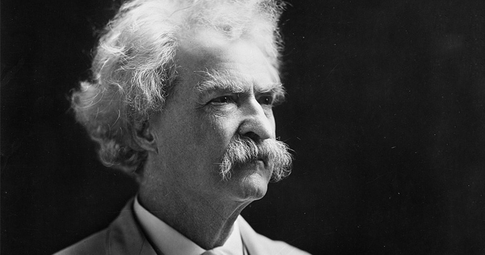 Mark Twain insisted that "conscience and honor" must come before party loyalty — a view as unfashionable now as it was in 1884. |
Then came June 6, 1884.
Twain was at his home in Hartford, Conn., playing billiards with Republican friends, when they received what Chernow calls "the shocking news from Chicago" that the Republican national convention had nominated James G. Blaine of Maine for president.
"The butts of the billiard cues came down on the floor with a bump, and for a while the players were dumb," Twain later recalled. Blaine, a former speaker of the House, US senator, and secretary of state, was seen by his critics as the very embodiment of a Gilded Age political operator — deeply entangled with railroad interests and implicated in influence-peddling schemes so much so that a famous Democratic campaign rallying cry mocked him as "Blaine, Blaine, James G. Blaine, the continental liar from the state of Maine." For Twain, no less odious was Blaine's advocacy of the racist Chinese Exclusion Act of 1882, the first law in US history to bar immigration by an entire nationality or ethnic group — a law Twain reviled as a barbaric throwback to the 11th century, akin to "a medieval edict against the Jews."
Blaine represented everything principled Republicans were supposed to shun. Yet now he was the party's standard-bearer. And most of the party's leading lights fell in line behind him.
The Hartford Courant, a Republican paper that had spent years denouncing Blaine's corruption, reversed itself within days and endorsed him enthusiastically. "Within 30 days after the nomination," Twain bitterly remarked, "that paper had him all painted up white again." He was stunned that so many Republican friends he had always regarded as upright and principled — people who, in today's social media lingo, would have deemed themselves #NeverBlaine Republicans — would embrace such a tainted candidate simply because he wore the party label.
Nor were Twain and his Hartford circle alone in their revulsion. A handbill circulated that summer among Republicans and independents in Chicago put it starkly: Blaine's "record is notorious [for] its utter lack of principle," it declared. His nomination "has compromised the Republican Party, and his election would dishonor the nation."
"Isn't human nature the most consummate sham and lie that was ever invented?" Twain wrote to his longtime friend, the writer and editor William Dean Howells. "Isn't man a creature to be ashamed of in pretty much all his aspects?"
It is hard, in 2025, not to hear an echo there.
I have been a conservative all my adult life, a Reaganite by instinct and conviction. Donald Trump was exactly the sort of demagogue that conservatives and Republicans once rejected without hesitation — a man whose indecency, mendacity, and contempt for constitutional norms should have rendered him unelectable. When Trump first declared himself a candidate for the 2016 Republican presidential nomination, a Fox News poll found that he was "by far the most unpopular" contender in the field. Of likely Republican voters back then, 59 percent said Trump was someone they would "never vote for." Even after it became clear that Trump might well be the Republican nominee, plenty of leading conservatives and Republicans continued to oppose him.
But only for a while. Long before the 2020 campaign had begun, many of Trump's most resolute Republican foes had transformed themselves into some of his most fervent public supporters. They discovered reasons to praise him, defend him, and even imitate him. What they once dismissed as disqualifying somehow became, in the heat of partisan combat, negotiable. It was a familiar spectacle: a party's moral immune system failing just when it was needed most.
Blaine's nomination was a key moment in the evolution of Twain's political outlook. Turning his back on mainstream Republicans, some of them close friends and neighbors, he defected to a group of reformist Republicans who refused to support a candidate they believed so unworthy of public trust. The Never Blaine Republicans were jeered as "little mugwumps" by The New York Sun — the term comes from an Algonquin word for "great chief" — but the intended insult was adopted by the mavericks as a badge of honor. For his part, Twain readily identified himself as a Mugwump — "pure from the marrow out," his daughter Susy quoted him as saying.
"At a time of bitter partisanship, it was no small thing to bolt a party, but Twain stuck to his position despite local ostracism," Chernow notes. To a Republican who admonished him to support Blaine for the good of "the country and the party," Twain replied: "Certainly allegiance to these is well; but as certainly a man's first duty is to his own conscience and honor — the party and the country come second to that, and never first."
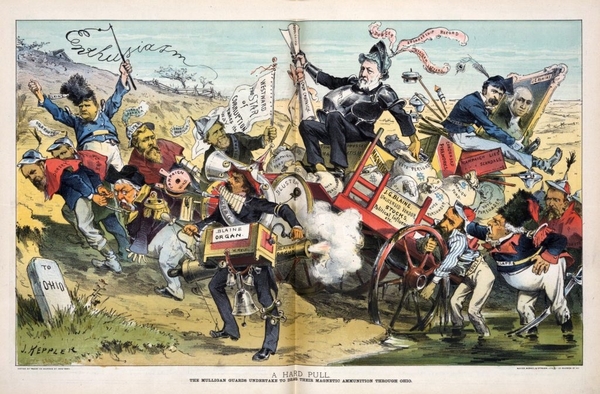 This 1884 cartoon in Puck by Joseph Keppler, "A Hard Pull," depicts the Republican Party struggling to haul James Blaine and his many scandals out of the swamp. |
Reading those lines, I thought of the many conservatives I admired — some of them friends — who knew exactly who Trump was, denounced him early, and then, when he won the nomination or the presidency, persuaded themselves to swallow the very things they had once condemned. They told themselves the country came first, the courts came first, the economy came first, beating the Democrats came first. Twain heard it all a century and a half ago and had no patience for it. To him, such reasoning was not prudence but evasion — the first step in training oneself to accept what one knows to be wrong. In his view, the moment a party teaches its members to ignore their own moral senses, it has already begun to hollow itself out.
Twain was ostracized in "certain quarters of Hartford society" for many years, according to Chernow. Some Republican newspapers refused to cover his speeches. But Twain, who regretted many things in life, never regretted taking his stand with the Mugwumps or contending that in choosing political leaders, character always matters most.
The Mugwumps of 1884 were more fortunate than the Never Trumpers of our day: The Democratic presidential nominee that year was Grover Cleveland, a man renowned for his integrity, committed to reform, and strong enough to face down crooked political schemers. The Mugwump defectors helped him defeat Blaine, ending the presidential aspirations of "the continental liar from the state of Maine." Had the Democratic Party in 2016 nominated someone of Cleveland's caliber rather than Hillary Clinton, who was so widely regarded as dishonest and untrustworthy, America's political culture might not have become nearly as toxic as it did.
Nevertheless, the virtue of Twain's Mugwump stance does not depend on having a Grover Cleveland waiting on the other side. It depends on believing that no party deserves your loyalty when it betrays your principles.
Twain held to that belief for the rest of his life. In a 1901 speech in New York titled "The Causes of Our Present Municipal Corruption," he reminded his audience that they had the power to topple corrupt officeholders, if only they chose to deploy it: "Vote for the best men for the offices, no matter what party they belong to."
Long before the advent of the internet and social media, Twain lamented the way partisanship and ideology encourage people to huddle in echo chambers that reinforce their own opinions and shut out information that might force them to rethink their view. The average citizen, Twain wrote, too often cloaks himself in party dogma, not wanting "to know the other side — he wants arguments and statistics for his own side, and nothing more."
Twain's parting shot as a Republican still feels oddly contemporary: "I easily perceive that the Republican Party has deserted us, and deserted itself." He meant that he had stayed put; it was the party that had walked away from its own code. (Ronald Reagan would later say much the same of his departure from the Democrats.)
Political movements do not rot because they acquire a single flawed leader. They rot when their members decide that integrity is optional, that character is an inconvenience, and that it is more dangerous to disagree with a party's leader than to let him have his way. Twain lived through one such moment. We are living through another.
To be clear, Chernow's excellent biography is not chiefly a political book — Twain's Mugwump revolt occupies only a sliver of its 1,000-plus pages — but it is rendered with such clarity that it lingers long after the larger story has moved on. It reminds us how fortunate the Republican Party once was to have within its ranks a critic so fearless, so morally lucid, and so unwilling to pretend that wrong was right simply because his party said so.
America could use such a voice again. So could the GOP.
* * * * * * * * * * * * * * * * * * * * * * * * * * * * * * * * * * * * * * * * * * * * * * *
What I Wrote Then
24 years ago on the op-ed page
From "Bikers demand their 'civil rights'" Nov. 29, 2001:
For a real threat to freedom, consider a story in Monday's New York Times.
The story reports the efforts of Ohio motorcycle clubs to promote a bill banning discrimination against motorcycle riders. In Ohio as elsewhere, some restaurants and bars refuse to serve customers who show up looking like Marlon Brando in "The Wild One." There are motels where "Vacancy" signs are switched off when a herd of motorcycles swarms into the parking lot. Bikers resent the assumption that they are marauding thugs, and many think such anti-motorcycle animus should be illegal.
Accompanying the story is a picture of Carl Campbell, who "weighs just over 300 pounds without his biker boots and riding leathers." He likes to ride "a very large motorcycle," the story notes, "ideally in a thundering herd of fellow members" of his club. In the photo, the bearded Campbell glowers, beefy arms folded, eyes hidden behind sunglasses, head covered by a bandana. It is a look some people might call threatening.
Not Campbell, though. "I'm not trying to scare anybody," he insists. "That's just the way I dress." The fact that other people might in fact be scared by him ... does not, in his view, give a restaurant or hotel owner the right to refuse him service.
* * * * * * * * * * * * * * * * * * * * * * * * * * * * * * * * * * * * * * * * * * * * * * *
The Last Line
"And the tree was happy." — Shel Silverstein, The Giving Tree (1964)
* * * * * * * * * * * * * * * * * * * * * * * * * * * * * * * * * * * * * * * * * * * * * * *
Jeff Jacoby is a columnist for The Boston Globe.
-- ## --
Follow Jeff Jacoby on X (aka Twitter).
Discuss his columns on Facebook.
Want to read something different? Sign up for "Arguable," Jeff Jacoby's free weekly newsletter.