





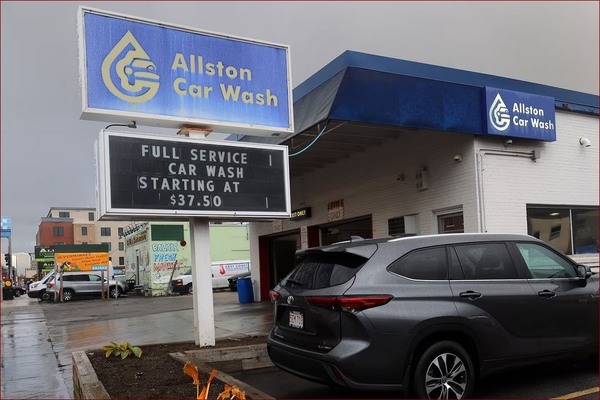
 In a raid on Nov. 4, ICE agents detained nine workers at the Allston Car Wash in Boston. |
(This column is an excerpt from Arguable, my weekly newsletter. To subscribe for free, visit globe.com/arguable.)
THE ALLSON Car Wash has been a fixture on Boston's busy Cambridge Street since I was a law student decades ago. This month, it became the focus of a significant news story. On the morning of Nov. 4, federal Immigration and Customs Enforcement agents raided the business and took nine employees into custody. The Globe reported that the five women and four men, most of them from Central America, had valid work permits and none had any criminal record.
Then the story took an unexpected twist: A Boston University student claimed credit for the raid.
"I've been calling ICE for months on end," Zac Segal, the president of the BU College Republicans chapter, exulted in a post on X. "This week they finally responded to my request to detain these criminals. As someone who lives in the neighborhood, I've seen how American jobs are being given away to those with no right to be here. Pump up the numbers!"
Whether Segal's dime-dropping actually triggered the ICE raid is unclear, but his social media post drew plenty of hostile comment. He was denounced as a racist, a bigot, a terrible person, a "sicko." But there were numerous messages of praise as well: "You did the right thing," one supporter cheered. "You're a hero and a true patriot," declared another.
Reveling in the attention, Segal doubled down in a follow-up message.
"I reported suspicious activity to law enforcement because that is what any American should do," he wrote. "My intention was simple: to protect my community and uphold the rule of law."
People like Segal and his admirers are nothing new. There has never been a shortage of individuals willing to betray vulnerable neighbors while telling themselves that it's what good citizens do. Segal fits an all-too-odious pattern: the self-anointed defender of law and order — or morality, or national security — who convinces himself that informing on others is not only justified but virtuous.
In the 1850s, when the Fugitive Slave Act turned human freedom into contraband, many citizens even in Northern states applauded those who helped capture fugitives so they could be returned to slavery. "Our citizens are determined that the laws shall be enforced," one Pennsylvania newspaper thundered in 1851. "Every attempt at resistance or violence will be indignantly frowned down."
Following the attack on Pearl Harbor, Japanese Americans found themselves monitored by neighbors who phoned in "suspicious" behavior to the FBI. Informers defended their behavior as patriotism rather than prejudice — even as it helped pave the way for the incarceration of some 120,000 innocent Japanese Americans by the federal government.
Elsewhere, some of the most terrifying regimes of the 20th century relied on informers — from those who alerted the Gestapo to Jews in hiding during the Holocaust to those who collaborated with the Stasi secret police in communist East Germany.
The president of BU College Republicans is not a singular villain. He is merely a shabby case study in how the impulse to capsize the lives of powerless people can persuade itself that it's upholding the public interest. Segal insists he acted solely "to protect my community and uphold the rule of law" — as though yanking hardworking migrants from their modest jobs and spreading fear through a neighborhood known for its rich international flavor is the way to make society stronger or safer.
The moral grotesqueness is heightened by the gulf between Segal, a privileged student at an elite university, and the nine humble workers he spent "months on end" urging federal agents to arrest — people who wash cars and vacuum floor mats for a living, and whom he dismissed because they had "no right to be here."
What lingers after the raid in Allston — after nine workers lost their freedom, a neighborhood was traumatized, and a Republican student basked in momentary notoriety — is a question: What does it mean to be a neighbor?
Every era produces people eager to turn informer. What separates durable societies from brittle ones isn't the existence of such people — there will always be some — but how the rest of us react. Do we indulge that instinct, especially when the targets are disfavored minorities? Or do we insist that a community's dignity is measured by how it treats those with the least power?
Segal says he acted "to protect my community." But communities aren't strengthened by fear or suspicion. They're held together by something quieter and harder: the habit of treating the people around us — even those who wash cars or speak with an accent — as fellow human beings whose presence enriches us more than it threatens.
"Someone who lives in the neighborhood," Segal called himself. He ought to take a cue from the real neighbors in Allston, who quietly rallied in the days after the raid to support the arrested workers' families. They know, even if Segal doesn't, that community isn't built by calling ICE, but by showing up when people need help.
Jeff Jacoby is a columnist for The Boston Globe.
-- ## --
Follow Jeff Jacoby on X (aka Twitter).
Discuss his columns on Facebook.
Want to read something different? Sign up for "Arguable," Jeff Jacoby's free weekly newsletter.