





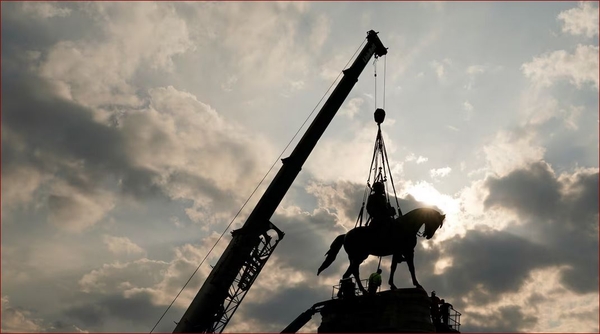
 Crews removed a towering statue of Confederate General Robert E. Lee on Monument Avenue in Richmond, Va., in 2021 |
PRESIDENT TRUMP addressed the troops at Fort Bragg, N.C., earlier this month, delivering a speech so partisan, it was likened to a campaign rally. In addition to prompting uniformed troops and their families to jeer the press and boo the mention of former president Joe Biden, Trump derided Los Angeles as a "trash heap," labeled the governor of California "Gavin Newscum," and railed against undocumented immigrants as "the most heinous people."
He also announced that he would restore the names of all Army bases that were named for Confederate generals during the Jim Crow era — names that Congress ordered changed in a law passed over Trump's veto in 2020.
Among those bases was Fort Bragg. Originally named for the undistinguished Confederate general Braxton Bragg in 1918, it was redesignated Fort Liberty in 2023. Last year Trump vowed that if he returned to the White House, he would resurrect the former name. In February, Defense Secretary Pete Hegseth signed an order changing the huge installation's name back to Fort Bragg.
But to circumvent Congress's mandate that military facilities no longer evoke Confederate officers who fought against the United States in defense of slavery and the rupture of the Union, the name change came with a twist: The Pentagon now claims Fort Bragg honors a little-known World War II private named Roland L. Bragg — not the Confederate general.
On June 11, the Army announced it would use the same disingenuous ploy to reinstate the names of seven other military bases that bore the names of Confederate generals. Thus, Fort Lee in Prince Georges County, Va., which formerly commemorated General Robert E. Lee, the commander of the Confederate Army, will henceforth honor Fitz Lee, a Black soldier who received the Medal of Honor for his valor in the Spanish-American War.
But during his appearance at Fort Bragg, Trump didn't trouble to keep up the pretense.
"For a little breaking news," he said, "we are also going to be restoring the names to Fort Pickett, Fort Hood, Fort Gordon, Fort Rucker, Fort Polk, Fort A.P. Hill, and Fort Robert E. Lee. We won a lot of battles out of those forts. It's no time to change."
Though the Pentagon may have a new namesake for Fort Lee, Trump's loyalty clearly lies with the original Confederate leader. His rhetoric may play well with his base. But it rests on a perversion of history — above all when it comes to figures like Lee. Before embracing the return of Lee's name to a US Army facility, it's worth recalling who he actually was and what he truly stood for.
As a kid in grade school, I was taught that while Lee fought on the wrong side during the Civil War, he was a good and gallant American who personally detested slavery and backed the Confederacy only out of loyalty to his home state. For decades, that was the received wisdom. Even some US presidents echoed it.
Dwight Eisenhower extravagantly praised Lee as "selfless almost to a fault and unfailing in his faith in God ... noble as a leader and as a man, and unsullied." Franklin Delano Roosevelt lauded him as "one of our greatest American gentlemen," and even Ronald Reagan praised Lee because he "criticized secession and called slavery a great moral wrong."
This is a fable — "The Myth of the Kindly General Lee," as Adam Serwer dubbed it in an essay for The Atlantic. It is far more fiction than fact, sustained by the long propaganda campaign of Lost Cause ideologues, who for generations have whitewashed the Confederacy and its objectives. But presidential testimonials cannot change clear and well-documented facts: When it mattered most, Lee was not an American patriot, he was not an opponent of slavery, and he never acquiesced in the equality of freedmen as American citizens.
As the Lee legend was first being manufactured in the decades following the Civil War, abolitionists and civil rights advocates did their best to debunk it. Frederick Douglass, the foremost Black leader of his age, despised the "bombastic laudation" of Lee. He wrote, shortly after the ex-general's death in 1870, "We can scarcely take up a paper that ... is not filled with nauseating flatteries of the late Robert E. Lee."
The historian John Reeves debunked much of this mythology in a 2018 book, "The Lost Indictment of Robert E. Lee."
Lee insisted after the Civil War that "the best men of the South" — a group in which he obviously included himself — had always "been anxious to do away with this institution" of slavery. In reality, as Reeves documented, the "best men of the South" — or at least the South's most prominent politicians — engineered secession for the explicit purpose of upholding slavery. Every state that joined the Confederacy, including Lee's Virginia, cited the preservation of slavery as integral to its motivation.
Lee embraced that attitude. For decades he had been an enslaver. At the start of the war, he held approximately 200 individuals as property and was known for breaking up enslaved families and brutally punishing recaptured runaways. True, he once opined, in a letter to his wife, that "slavery as an institution is a moral and political evil." But his next words clarified that his view had nothing to do with sympathy for the men and women held in bondage.
"I think it however a greater evil to the white man than to the black race, & while my feelings are strongly enlisted in behalf of the latter, my sympathies are more strong for the former," he wrote. "The blacks are immeasurably better off here than in Africa, morally, socially & physically." Slavery, he added, was "necessary for their instruction as a race, & I hope will prepare & lead them to better things. How long their subjugation may be necessary is known & ordered by a wise Merciful Providence. Their emancipation will sooner result from the mild & melting influence of Christianity, than the storms & tempests of fiery Controversy."
In short, while Lee considered slavery undesirable in the long run, he regarded it as "necessary" for Black people's welfare. And he firmly believed its demise should be left patiently in God's hands, not hastened by abolitionists and their "fiery Controversy."
No less ludicrous than the myth that Lee hated slavery is the insistence that he should not be faulted for having sided with Virginia and the Confederacy instead of fighting for the Union. But Lee understood the moral wrong he was committing by breaching his oath of loyalty to the United States.
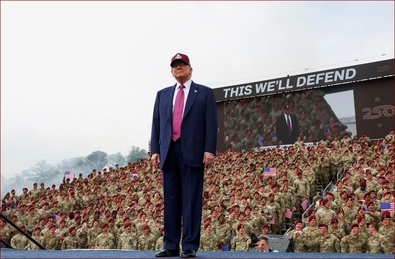 President Trump delivers remarks during a visit to Fort Bragg, N.C., June 10, 2025. |
"Secession is nothing but revolution," he wrote in a letter to his son before the outbreak of war. Treason is the only crime defined in the Constitution, as Lee was well aware. It is construed precisely in Article III, Section 3: "Treason against the United States shall consist only in levying war against them, or in adhering to their enemies, giving them aid and comfort."
Lee spent the better part of four years "levying war against" the United States and "adhering to their enemies." That made him an American traitor, not an American hero. To have named a US Army base after him was an appalling blunder, one that Congress belatedly corrected.
By pledging to undo that correction and to reattach names like "Fort Robert E. Lee" to American military installations, Trump isn't upholding history. He is defiling it. Lee and other Confederate leaders waged war on their country to keep fellow human beings in chains. No patriot can make America great again by honoring such men.
Jeff Jacoby is a columnist for The Boston Globe.
-- ## --
Discuss his columns on Facebook.
Want to read something different? Sign up for "Arguable," Jeff Jacoby's free weekly email newsletter.