






|

* * * * * * * * * * * * * * * * * * * * * * * * * * * * * * * * * * * * * * * * * * * * * * *
Baby, it's hot outside
It has been a bazillion degrees this weekend in much of the eastern United States, and naturally the media couldn't resist the temptation to connect the short-term heat wave to long-term climate change. When global-warming skeptics point to blizzards, cold snaps, ice storms, and persistent polar vortices — or to fresh instances of the Gore Effect — the alarmists invariably respond with a condescending reminder that weather isn't climate, and that a temporary Deep Freeze or snowy nor'easter doesn't negate the long-term shift in climate. But, being human, they yield to the temptation to do the exact same thing — link weather to climate — when we get a scorcher.
Which is why over the last couple days there were so many headlines like these:
"Heat Waves in the Age of Climate Change: Longer, More Frequent and More Dangerous" (New York Times)
A Deadly Heat Wave After the Hottest June On Record: How the Climate Crisis Is Creating 'a New Normal' (Time)
Ongoing heat wave illustrates a hallmark of our changing climate: Warmer nights (Washington Post)
For reasons I've discussed on numerous occasions, I am skeptical of the panicky claim that climate change is an existential threat to life as we know it. Human existence isn't going to come to an end in 12 years unless we abandon the use of fossil fuels. The earth's climate — climates, really; there isn't just one — is always changing and presumably always will. Whatever challenges may be posed by a period of warming, human beings will adapt to them, just as they have always adapted to shifts in climate. Indeed, they will adapt even more successfully than previous generations have, thanks to ever-more sophisticated technology.
But never mind all that. It's too hot for a climate change argument. I bring this up because readers have been sending me links to stories about how dangerous extreme heat can be, such as this one from the BBC , which begins: "This weekend, close to 200 million Americans will face temperatures of 90 degrees (F) and higher. Add in humidity, and many cities across the East Coast and Midwest will be feeling more like 110 degrees." The story notes that "heat waves have killed more people on average than any other extreme weather event in the US, according to the Centers for Disease Control (CDC)."
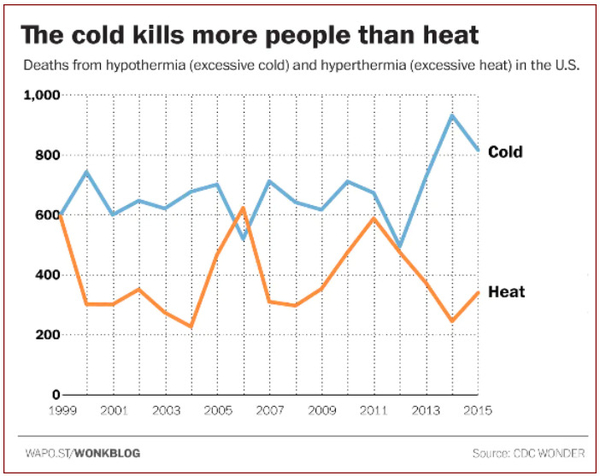
It may well be that an extreme heat wave is deadlier in the short run than an extreme cold spell. But on the whole, it is cold weather, not hot, that claims more lives — as the selfsame Centers for Disease Control has consistently affirmed. Here are excerpts from a 2016 report in The Washington Post:
Cold Temperatures Kill More Americans Than Hot Ones, CDC Data Show
The polar vortex is back with a vengeance in certain parts of the country this week. Here in northwest Minnesota, Saturday's temperature is expected to top out at minus-10 degrees, with a low of minus-27 on Saturday night.
Once you factor in wind chill, the temperature will feel like minus-45 or so. As the National Weather Service helpfully reminds us, in these temperatures "frost bite can occur quickly and even hypothermia or death if precautions are not taken."
Personally, I'll take crazy cold over crazy heat any day — you can always add layers if you're cold, after all, but if you're hot once you're buck naked there's really not much more to do. But data from the Centers for Disease Control and Prevention has consistently shown that excessive cold presents a greater threat to life than excessive heat. Take a look at the chart below, plotting annual deaths from hypothermia (too much cold) and hyperthermia (too much heat) in the United States from 1999 to 2015.
Like the Post reporter, my own preference is for cooler over warmer. Summer has always been my least-favorite season. Hot weather makes me miserable. It perplexes me that anyone can tolerate the heat and humidity of Houston, New Orleans, or Washington; even Boston gets too hot for my taste. I don't complain about snow or cold in the winter, but I definitely start kvetching once the thermometer climbs above 70 degrees each spring.
Yet as much as I hate hot weather, and as much as I don't personally relish the thought of a warming climate, I can recognize that global warming tends to be better for the preservation of human life than global cooling.
A 2014 paper by researchers from the National Center for Health Statistics and the National Center for Environmental Health examined heat-, cold-, and weather-related deaths in the United States from 2006 through 2010. The found that about 2,000 US residents died each year from weather-related causes of death. About 31% of those deaths were attributed to excessive heat or sun stroke. More than twice as many deaths — 63% — were attributed to exposure to excessive natural cold or hypothermia. The remaining 6% were attributed to floods, storms, or lightning.
And what is true for the United States — that hypothermia is responsible for ending more lives than hyperthermia — is even truer for the planet as a whole.
According to a major study published in The Lancet, the British medical journal, in 2015, cold weather worldwide kills 20 times as many people as hot weather. The study analyzed more than 74 million deaths in 384 locations across 13 countries. It found not only that cold weather is deadlier than hot weather, but that moderate cold weather takes more lives than short-lived but extreme cold snaps.
"Cold weather kills," write meteorologist Joseph D'Aleo and energy expert Allan MacRae at the US Issues blog. "Throughout history and in modern times, many more people succumb to cold exposure than to hot weather." Contrary to popular belief, they argue, Earth is on average colderthan is optimal for human survival. "A warmer world, such as was experienced during the Roman Warm Period and the Medieval Warm Period, is expected to lower winter deaths [while] a colder world like the Little Ice Age will increase winter mortality, absent adaptive measures."
If you're like me, you'll take cooler weather over hotter any day. But for the sake of the human race, you should pray for warming. Because a world that's not as cold will be a world that's not as lethal.
* * * * * * * * * * * * * * * * * * * * * * * * * * * * * * * * * * * * * * * * * * * * * * *
The Last Line
"But if it had to perish twice,
I think I know enough of hate
To say that for destruction ice
Is also great
And would suffice." — Robert Frost, "Fire and Ice" (1920)
* * * * * * * * * * * * * * * * * * * * * * * * * * * * * * * * * * * * * * * * * * * * * * *
Jeff Jacoby is a columnist for The Boston Globe.
-- ## --
Follow Jeff Jacoby on X.
Discuss his columns on Facebook.
Want to read something different? Sign up for "Arguable," Jeff Jacoby's free weekly newsletter.