






For most of the 1970s and 1980s, James "Whitey" Bulger and Stephen Flemmi ruled Boston's underworld through terror and bloodshed. They extorted business owners, peddled drugs, and murdered — sometimes to consolidate their empire, sometimes out of paranoia or caprice. They were sociopaths who traumatized their communities and got away with it for years, protected by their status as FBI informants. Eventually they were caught and prosecuted for a litany of savage crimes, including homicide, racketeering, and drug trafficking, and were sentenced to spend the rest of their lives behind bars. In 2018, Bulger was beaten to death by inmates at a federal penitentiary in West Virginia — a ghastly and pitiless end to a monster who sent so many others to early graves.
If there is anywhere on earth where the names of Bulger and Flemmi are likely to induce revulsion, it is in the Boston neighborhoods that bore the brunt of their brutality. In Dorchester and South Boston, their victims weren't faceless strangers: Many were neighbors, relatives, and friends. They were people like Eddie Connors, who ran Dorchester's popular Bulldogs Tavern until he was gunned down by Bulger and Flemmi in a nearby phone booth in 1975, or Debra Davis, the young beauty who at 17 was groomed by Flemmi to be his girlfriend, only to be strangled to death at 26 by Bulger because he decided she "knew too much."
So it isn't hard to understand the shock waves triggered when the owners of a Dorchester restaurant, embarking on a revamp of the place, decided to adorn its walls with oversize photographs of the two notorious killers.
"The first thing patrons see when they walk into Savin Bar and Kitchen is a poster-sized mugshot of the late notorious South Boston gangster, James 'Whitey' Bulger," reporter Shelley Murphy wrote in a recent Page 1 story in the Globe. "A mugshot of his partner in crime, Stephen 'the Rifleman' Flemmi, hangs on another brick wall of the Dorchester restaurant."
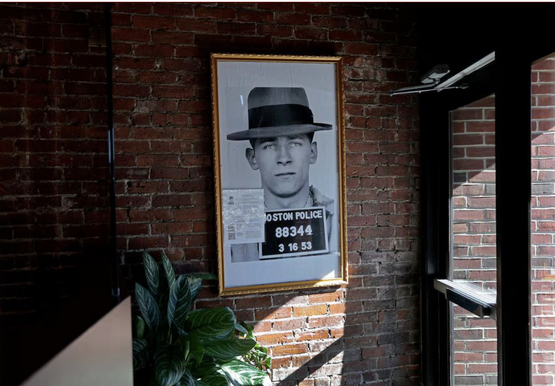 The malevolent gaze of this cruel Boston gangster sets the tone for Savin Bar & Kitchen in Dorchester. |
The owners of Savin Bar — which is located on the same block where Eddie Connors's tavern, Bulldogs, once stood — were encouraged by celebrity TV chef Gordon Ramsay to play up the neighborhood's link to the infamous serial killers. When Kenneth Osherow and Driscoll DoCanto opened the eatery in 2011, they promised to make it a place "where people feel comfortable going a few times a week." Now, apparently, they have other priorities.
"We're not hanging those images to celebrate them, but to recognize a chapter in the gritty story of our neighborhood," Osherow told Murphy. "We're acknowledging the history of this very spot." In a letter to the Globe, he reiterated that claim: "The images displayed are mug shots, reminders of accountability, not admiration," he wrote. "By acknowledging this past, we honor Boston's resilience and evolution."
But serving brunch and cocktails beneath poster-sized portraits of murderers, elegantly matted and framed, is not how you acknowledge history; it's how you romanticize evil.
If the proprietors of Savin Bar had truly wished to meaningfully convey the neighborhood's history, the framed photographs would be of Connors or Davis or some of the others whose lives were destroyed by Bulger and Flemmi. True remembrance centers the victims of murder, not the perpetrators.
Perhaps Ramsay and his production team believed that turning mobsters into wall décor was an appropriate way to showcase Boston's "gritty" past. Maybe it never occurred to them or to Savin Bar's owners that what might come across as edgy and stylish on a chef's TV reality show would feel like desecration to neighborhood residents.
But many of those residents have been vocal in their outrage.
"How can you go into a restaurant that says it's a community restaurant," Donna Blythe-McColgan, whose family has lived in the neighborhood for generations, said in a WBZ interview, "with photos of the very people who murdered and maimed many of the people in this community?"
To be fair, Savin Bar's obtuseness isn't unique. It's merely a local variant of a larger cultural sickness — the glamorization of evil. From Hollywood movies that portray mass killers as sympathetic, to T-shirts and mugs emblazoned with the faces of communist butchers, to Mafia-themed party decorations, depravity is treated as charisma.
This perversity has become ubiquitous. Think of Rolling Stone's cover photo of Dzhokhar Tsarnaev, which rendered the Boston Marathon terrorist as a brooding rock star. Think of Manhattan's KGB Bar, a watering hole named for the Soviet Union's grim security network of secret police and torture sites that features Soviet propaganda posters and a hammer-and-sickle flag. Think of President Trump's 2024 campaign promise to restore the names of Confederate generals to the Army bases from which Congress had ordered them removed.
The same moral blindness runs through it all. Making images of evil fashionable doesn't sanitize what they stand for. Defending monuments to slavery and those who fought to preserve it on the grounds that they are emblems of "heritage" is equally dishonest and dishonorable. And hanging framed mugshots of Whitey Bulger and his partner in a Dorchester restaurant is a homage to murderers, no matter how piously the owners deny it.
Particularly feeble is Osherow's excuse that because the images featured on Savin Bar's walls are mugshots, they serve as "reminders of accountability, not admiration." The power of a mugshot depends entirely on context. Some police photos have indeed become icons of esteem — think of Rosa Parks's mugshot, taken during the Montgomery bus boycott, or that of Martin Luther King Jr., arrested in Birmingham in 1963. Other mugshots have been turned into symbols of defiance or martyrdom. A mugshot isn't inherently a rebuke; it can just as easily become a banner.
In a restaurant, wall hangings are meant to set the mood. Guests read the space before they eat or drink anything. When the first thing they see is the framed face of a gangster, elegantly lit against a brick wall, the message isn't accountability — it's atmosphere. No dining room displays mugshots to emphasize shame. They do it to signal edge, swagger, attitude. If you doubt that, ask yourself why no one proposes lining a dining room with mugshots of drunk drivers, wife beaters, or child abusers.
There are ways to confront a painful past with dignity and truth.
In Europe, the Stolpersteine Project marks the doorways of Holocaust victims with small brass plaques — "stumble stones" — embedded in the pavement, each engraved with a name and fate. Passers-by are reminded that real people once lived there until they were destroyed by the Nazis.
In Montgomery, Ala., the National Memorial for Peace and Justice pays tribute to the thousands of Black Americans lynched to death; each victim is honored by a rust-colored steel column hanging in a quiet, somber space. There are no statues of the killers, no nostalgic murals of Southern heritage — only the unflinching recognition of what was done and to whom.
In Boston, the 9/11 Memorial at Logan Airport honors the passengers and crew of the two flights that took off from Boston on that awful morning, only to be hijacked by terrorists and crashed into the World Trade Center. The memorial is a glass cube, inscribed with the names of the victims, and accessed by two walkways that mirror the flights' paths.
That is how history should be remembered: with humility for the dead, not glamor for their tormentors.
Boston has never lacked for grit. What it needs, always, is moral sense. Those Dorchester residents who have spoken out against the mugshot motif understand that difference. They know there's nothing trendy about hanging killers' portraits on a restaurant wall. That isn't history; it's a cynical attempt to refashion one of Boston's darkest chapters as ironic interior design.
Bulger and Flemmi weren't colorful rogues or local celebrities. They were cruel, violent men who left a trail of corpses and broken lives. To turn them into décor is to strip that truth of all its gravity.
Boston once trembled before Whitey Bulger. It shouldn't now dine beneath his gaze.
* * * * * * * * * * * * * * * * * * * * * * * * * * * * * * * * * * * * * * * * * * * * * * *
What I Wrote Then
24 years ago on the op-ed page
From "Blindness to evil leads to more evil," Oct. 21, 2001:
"In this moment of crisis," writes [Stephen Jay] Gould, the renowned Harvard biologist, it is important to affirm the "essential truth" that "good and kind people outnumber all others by thousands to one" — as at Ground Zero, which has now become "a vast web of bustling goodness, channeling uncountable deeds of kindness." The horrors of history are caused not by a "high frequency of evil people," Gould says, but by the terrible destructiveness of "rare acts of evil."
But it is not true that human nature is essentially good or that evil is rare. And it is the worst kind of wishful thinking to believe otherwise.
* * * * * * * * * * * * * * * * * * * * * * * * * * * * * * * * * * * * * * * * * * * * * * *
The Last Line
"Our goal is not the victory of might, but the vindication of right — not peace at the expense of freedom, but both peace and freedom, here in this hemisphere, and, we hope, around the world. God willing, that goal will be achieved." — President John F. Kennedy, Address to the nation during the Cuban missile crisis (Oct. 22, 1962)
* * * * * * * * * * * * * * * * * * * * * * * * * * * * * * * * * * * * * * * * * * * * * *
Jeff Jacoby is a columnist for The Boston Globe.
-- ## --
Follow Jeff Jacoby on X (aka Twitter).
Discuss his columns on Facebook.
Want to read something different? Sign up for "Arguable," Jeff Jacoby's free weekly newsletter.