






Few New England sports fans need to be told that attending a big game has become expensive. David D'Alessandro, the former CEO of John Hancock, put words to a frustration shared by countless Boston fans when he lamented in a Globe op-ed last week that live entertainment — not only sporting events but also concerts and hit Broadway shows — is increasingly becoming a luxury good, out of reach for ordinary families.
Tickets to a Celtics or Bruins game frequently go for $400 or $500 per ticket, D'Alessandro wrote. Tack on the inescapable fees and taxes, along with the cost of parking and concessions, "and a family of four can easily spend $2,500 for a regular season game." And if you really want to experience sticker shock, he added, "check out any of the Seat Geek or Stub Hub World Cup offerings at Gillette Stadium in June."
He'll get no argument from me on any of that. But to my mind, D'Alessandro goes badly astray in the cure he proposes: a government-imposed cap on the resale price of tickets, limiting it to no more than 10 percent above face value. His goal is understandable — he wants to make games and concerts more affordable. But the policy he advocates would not make live entertainment more accessible. Like all price controls, it would simply make tickets harder to obtain.
The reason is straightforward. TD Garden holds roughly 18,000 people. When the Celtics are playing the Lakers, or the Bruins are in the playoffs, the number of fans wishing they could be inside might run into the hundreds of thousands. There is nothing the government can do to change that brute fact. When demand for a scarce good dramatically exceeds its supply, prices rise. Since antiquity, governments and rulers of every kind have tried to keep prices from obeying the law of supply and demand, often meting out dire punishments to violators. But reality isn't optional.
At the end of the 3rd century, the Roman emperor Diocletian issued an Edict on Prices that banned speculation and imposed price ceilings on a wide range of goods and services. "Profiteers" who bought goods that were in high demand and resold them at higher prices could face the death penalty. But the ambitious law failed. Inflation persisted. Goods were traded on the black market. Eventually the law was abandoned. Like countless sovereigns before and since, Diocletian discovered the hard way that price controls solve nothing. They worsen the problem they are intended to solve, leading to shortages, rationing, and even higher prices.
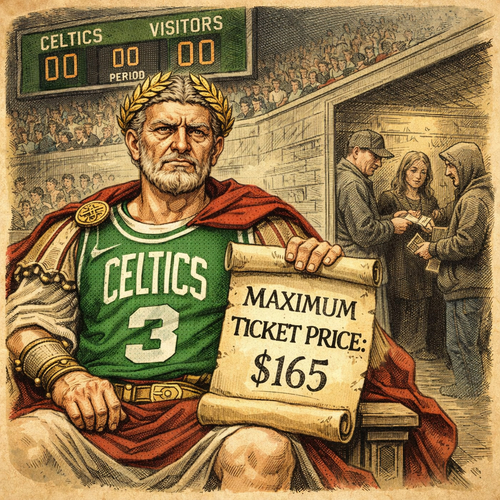 Even emperors can't repeal the law of supply and demand. |
What would a cap on ticket resale prices actually accomplish? Imagine that the law proposed by D'Alessandro — versions of which are circulating in legislatures from California to Washington, D.C. — were already in effect. A fan lucky enough to buy a Celtics ticket priced at $150 could legally resell it for no more than $165. But if the true market value of that seat on game night is $600, plenty of fans would still be willing to pay far more than the legal limit. The incentive to resell it quietly for that higher price would be overwhelming. Tickets would still change hands at higher prices — only now the transactions would take place off the books, through brokers, private networks, or whispered arrangements rather than in the open.
In every era, it seems, that lesson has to be relearned. Gasoline shortages in the 1970s — and the mile-long lines of motorists desperate to fill their tanks — were caused by government price ceilings. Thanks to New York's stringent rent controls, tenants have long paid under-the-table "key money" in order to secure a rent-stabilized apartment. In the 18th century, French authorities repeatedly tried to hold down the price of bread; the resulting shortages, black markets, and riots — including the notorious Flour War of 1775 — helped fuel the social unrest that eventually erupted in the French Revolution.
When prices are artificially suppressed, scarcity doesn't disappear; it simply reappears in less transparent forms.
Consider how strange the same policy would sound in other settings. During the Boston Marathon, hotel rooms within walking distance of the finish line can command astonishing prices. Airline tickets for flights on the Wednesday before Thanksgiving routinely cost far more than the same flight a week earlier. Limited-edition sneakers, rare baseball cards, and collectible vinyl records are all resold for multiples of their original price. Yet no one seriously proposes sending regulators to cap those resale prices at 10 percent above face value.
For the same reason, no one should try to deploy the power of the state to cap the resale price of a pair of Bruins ducats, or of tickets to "Hamilton" or "Wicked." Scarcity cannot be legislated away, and heavy-handed attempts to do so invariably backfire.
What critics lambaste as "ticket scalping" or "price gouging" would not be possible if tickets weren't underpriced in the first place. When seats for a major game or concert sell out in minutes and then reappear online at higher prices, that isn't evidence of some sinister plot. It is evidence that the original price was set way below what many fans were willing to pay all along.
D'Alessandro is far from the only critic urging a crackdown on the reselling of tickets. In an executive order signed last March, President Trump blasted "unscrupulous middlemen who sit at the intersection between artists and fans and impose egregious fees while providing minimal value." But it is clear that those middlemen are providing considerable value. Otherwise, no one would pay a premium to buy tickets from them and they would go out of business.
It isn't hard to understand why teams and performers often set the face value of their tickets below their true market worth. They might want to avoid the backlash that would come with charging what the market would bear. They may see it as a way to reward loyal season-ticket holders. They may simply prefer to see packed stadiums rather than risk empty seats. But the difference between the ticket's official price and its real price doesn't vanish. Someone will capture it — if not the team or the artist, then the fans who resell their tickets and the online brokers, such as StubHub and SeatGeek, that facilitate those sales.
In short, the secondary market simply reveals what the ticket was actually worth all along. Price caps won't change that reality. All they can affect is who reaps the windfall. More controls would reward the very people who already have the easiest access to seats: season-ticket holders, corporate buyers, and those with the time and connections to navigate presales and online queues. Everyone else would face an even steeper challenge finding a seat. Far from leveling the playing field for ordinary fans, price controls would tilt it further toward insiders.
Like D'Alessandro, many people wish that tickets to games, concerts, and theater could somehow be made more affordable.
But good intentions cannot repeal the effect of supply and demand on prices. When a large number of eager fans chase a much smaller number of seats, the price of admission will rise until supply and demand come into balance. If lawmakers forbid that price from emerging openly, it will emerge in other ways — through scarcity, favoritism, and transactions pushed into the shadows.
Lawmakers can decree many things. They can regulate ticket brokers, punish resellers, and threaten fines for charging more than officials think is fair. What they cannot do is conjure seats for 100,000 fans in an arena that holds only 18,000. Until some magician figures out a way to make that happen, the price of a coveted ticket will be determined the same way prices are determined everywhere else: by how many people want it and how little of it there is.
* * * * * * * * * * * * * * * * * * * * * * * * * * * * * * * * * * * * * * * * * * * * * * *
What I Wrote Then
24 years ago on the op-ed page
From "A walk in Havana," March 14, 2002:
Cuban officials rhapsodize about Cuba's "socialist equality," in which everyone is treated alike and there are no egregious disparities in wealth. But move around Havana with your eyes open and you see the reality. For Communist Party bigshots there are beautiful neighborhoods like Miramar, with its elegant mansions and gorgeous gardens. For ordinary Cubans there are the crowded, crumbling apartments of Centro Habana, where families live in squalor it would be hard to find in an American slum. "Much of Centro is so dilapidated," my guidebook says, "that [it] conjures up images of what Dresden must have looked like after the bombing."
Billboards all over Havana extol socialismo and revolución and dignidad, but the truth is that 43 years after Castro's socialist revolution, Cuba's dignity is in tatters. Educated Cuban women, desperate for dollars -- or to meet a foreign Prince Charming -- become prostitutes. Educated Cuban men on bicycles haul tourists around in rickshaws. Havana swarms with well-heeled foreigners, but to me it was a city full of sadness and frustration.
* * * * * * * * * * * * * * * * * * * * * * * * * * * * * * * * * * * * * * * * * * * * * * *
The Last Line
"When the doctors came they said she had died of heart disease — of joy that kills." — Kate Chopin, "The Story of an Hour" (1895)
* * * * * * * * * * * * * * * * * * * * * * * * * * * * * * * * * * * * * * * * * * * * * * *
Jeff Jacoby is a columnist for The Boston Globe.
-- ## --
Follow Jeff Jacoby on X (aka Twitter).
Discuss his columns on Facebook.
Want to read something different? Sign up for "Arguable," Jeff Jacoby's free weekly newsletter.