





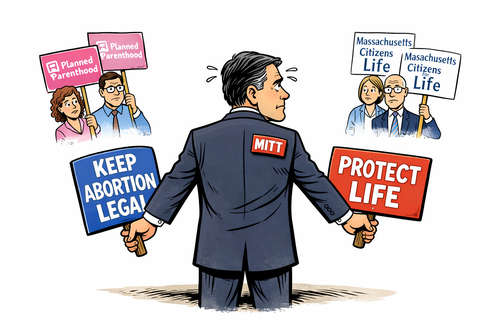
ABORTION POLITICS can be tricky. Consider the Massachusetts governor's race:
In this corner we have a Republican candidate — let's call him Mitt Romney — who has consistently said that he supports Roe v. Wade. He promises to "protect the right of a woman to choose under the laws of the country and the laws of the Commonwealth." He even endorses Medicaid funding for abortions.
Yet prochoice liberals are slamming Romney for his stance on abortion. They accuse him of "waffling" and doubt whether he can be relied on to defend abortion rights. "We are," says Planned Parenthood of Massachusetts, "deeply concerned."
In the same corner, meanwhile, is another Republican candidate — let's call him Mitt Romney too. He has always made clear his deep antipathy to abortion, which he calls "the wrong choice." Within his church he has counseled women against abortion. And last year he wrote to his local newspaper, "I do not wish to be labeled prochoice."
Yet prolife conservatives want no part of Romney and do not support his campaign. When Ann Scarpato, the president of Massachusetts Citizens for Life, is asked whether her organization might endorse Romney for governor, she replies, "There's little chance of that happening."
In short, Romney seems to have gained the worst of both worlds: Prochoicers don't trust him and prolifers don't want him. Whom does that leave?
Almost everyone.
The US media cover abortion politics as if Americans divided into warring camps: those who oppose abortion and want to ban it versus those who want it kept legal and widely available. But no such divide exists. The great majority of Americans believe abortion is very wrong. The great majority of Americans also believe women should have the right to choose abortion. Romney's views couldn't be more mainstream.
Reams of survey research bear out this ambivalence. In June 2000, the Los Angeles Times asked a national sample of respondents whether abortion is tantamount to murder. A solid majority, 57 percent, said yes. In the same month, an NBC/Wall Street Journal poll asked whether the choice of abortion should be left to the woman and her doctor. Again, 57 percent said yes.
For years, Gallup has asked whether abortions should be legal in all cases, only in certain cases, or never. About one-fourth say legal always — the ultra-prochoice position. About one-fifth say legal never — the ultra-prolife position. More than half, however, would keep abortion legal, but only in certain cases, such as when the pregnancy was caused by rape or when the baby would be born with a serious defect.
You wouldn't know any of this from the way the media cover abortion. As a rule, they focus on the extremists — those who defend abortion at any time for virtually any reason and those who would forbid abortion in nearly every case. The prochoice extremists often include the media themselves, which helps explain why reporters and pundits so often put Republicans under the abortion microscope while rarely finding anything to scrutinize in the stands Democrats take on the subject.
But the extremists don't speak for the American people, most of whom come down roughly where Romney comes down: They know that abortion is gruesome and violent and that in hundreds of thousands of cases each year it amounts to little more than after-the-fact birth control, yet they support the right of women to decide on abortion for themselves. As with other ugly practices — smoking, pornography — the public combines strong disapproval with an equally strong commitment to individual choice.
For fear of offending the abortion lobby, the Democratic candidates for governor won't discuss abortion this candidly. Romney could, and it would be refreshing to hear him do so.
Ah, but that gets to Romney's real problem, which isn't what he stands for so much as a suspicion that he wants to stand for whatever is safe.
I like Romney. I admire his values. He is honorable, decent, and smart. But he is not a natural politician, and I think he finds it distasteful to take strong political positions, especially when they may affront some voters. During his race against Ted Kennedy in 1994, I wrote that "Romney looked good, spoke well, remained poised — and came down firmly on both sides of almost every issue." For a Republican running in a heavily Democratic state, that is a recipe for defeat. And Romney was indeed defeated — even as Bill Weld, who was running for reelection in the same year on a flinty platform of tax cuts, crime control, and welfare reform, roared to a record-busting victory.
Even in Massachusetts, Republicans cannot win by striving to sound as much like Democrats as possible. If Romney has learned that lesson, it's not too early to show it. He might even begin with abortion.
Jeff Jacoby is a columnist for The Boston Globe.
-- ## --
Follow Jeff Jacoby on X (aka Twitter).
Discuss his columns on Facebook.
Want to read something different? Sign up for "Arguable," Jeff Jacoby's free weekly newsletter.