





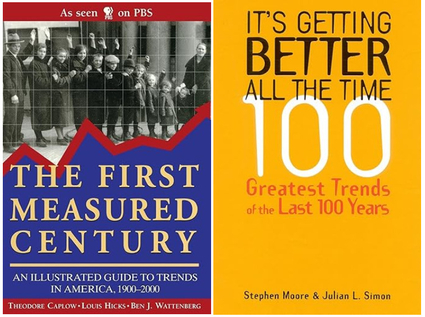
IF YOU'RE blue and you don't know where to go to, why don't you go to two engrossing new books, each brimming over with data about the extraordinary century just ended.
Ben Wattenberg, Theodore Caplow, and Louis Hicks open "The First Measured Century" with the words of James Garfield, who foresaw in 1869 that the new science of statistics would change the way history was written. "Till recently," the future president said in a speech to the US House of Representatives, "the historian ... gave us only the story of princes, dynasties, sieges, and battles.... Now, statistical inquiry leads him into the hovels, homes, workships, mines, fields, prisons, hospitals, and all the other places where human nature displays its weakness and its strength."
It was a prescient insight. By the time the 20th century arrived, write Wattenberg et al., Americans had become "the most energetic measurers of social life that ever lived." Few of us now can imagine living in a society that doesn't routinely take its own pulse — keeping tabs on marriage rates and divorce rates, tracking the rise and fall of crime and poverty, compiling data on everything from income to sports to sex.
Some of the 20th century trends surveyed in "The First Measured Century" will be news to no one. Who doesn't know that life expectancy is way up, that most Americans no longer live on farms but in suburbs, that nearly every home now has a television? But others may surprise you.
True or false: (1) Parents spend more time with their children today than in the 1920s. (2) Income inequality is lower now than it was early in the century. (3) Membership in churches is far higher now than it was at the start of the 20th century. Believe it or not, all three are true.
Not every trend has been a happy one, of course. Wattenberg and his co-authors make it clear that there has been bad news to go with the good. Examples:
A year's tuition at Harvard, just $3,000 in 1900, had rocketed past $22,000 (in inflation-adjusted dollars) by 1999.
Only 12 percent of black children were born out of wedlock at the time of World War I, but by 1997, that figure was up to an alarming 69 percent.
Per-capita spending on police protection grew sharply, from $13 in 1902 to $207 in 1996 (again, in constant dollars).
But on the whole, the 20th century was a period of vast improvement in the lives of Americans. The nation over which George W. Bush now presides is the healthiest, wealthiest, safest, best fed, best educated, most productive, and most comfortable in history. That stunning progress is the central theme of "It's Getting Better All the Time," a joyful new volume by Stephen Moore of the Cato Institute and his mentor, the late Julian Simon. Subtitled "100 Greatest Trends of the Last 100 Years," it sets out to dispel the miasma of gloom that so often enshrouds modern journalism and scholarship.
In their introduction, Moore and Simon sketch a portrait of 19th century life. It was "an era of tuberculosis, typhoid, sanitariums, child labor, child death, horses, horse manure, candles, 12-hour workdays, Jim Crow laws, tenements, slaughter houses, and outhouses," they write. "Lynchings were common .... About 1 in 4 American children perished.... Streets were smelly and garbage-filled.... Deadly diseases were carried by milk and what then qualified as 'drinking water.' "
"It's Getting Better All The Time" argues that the human condition advanced further in the past 100 years than in all previous centuries combined. Moore and Simon make their case with what has to be the most zestful and upbeat use of statistics ever gathered in one place: page after page of evidence that these are the good old days:
- As many as 1 woman in 100 died during childbirth in the 19th century. Today the ratio is 1 in 10,000.
- In 1900, an average homemaker devoted 84 hours per week to housework. By 1975, domestic drudgery had been cut to just 45 hours per week — and it is undoubtedly even lower today.
- The killer diseases of a century ago — tuberculosis, typhoid fever, polio, whooping cough — have been virtually wiped out.
- In the early 1900s, a typical family spent nearly 50 percent of its income on food. By 2000, the share of family income spent on food was down to 10 percent.
- In 1900, only 1 percent of Americans owned stock. As recently as 1980, only 13 percent did. Today, most of us — 52 percent — are shareholders.
- A mere 13 percent of American adults had a high school diploma in 1910. The figure now is 83 percent.
"The First Measured Century" and "It's Getting Better All The Time" may be the most readable collections of data ever assembled. They make it clear that the 20th century changed nearly everything — and that the greatest change occurred in the land where minds and markets were the freest.
Jeff Jacoby is a columnist for The Boston Globe.
-- ## --
Follow Jeff Jacoby on X.
Discuss his columns on Facebook.
Want to read something different? Sign up for "Arguable," Jeff Jacoby's free weekly newsletter.