





"Before you say another word," the man tells him coldly, "I think you ought to know: I'm a state legislator."
"That's OK," the barfly assures him. "I'll tell it very slo-o-o-wly."
Slowly, then.
In 1989 and 1990, as Mike Dukakis's "Massachusetts miracle" dissolved in a sea of red ink, Bay State lawmakers jacked up the state income tax. From 5 percent they hiked it to 5.75 percent, then hiked it again to 6.25 percent. It was the worst possible thing they could have done — raising marginal income tax rates suppresses economic growth — but they did get one thing right: They promised to keep the tax increase temporary.
In legislative debate and news accounts, the point was repeatedly driven home. When Dukakis wanted a permanent increase, Richard Voke, the House Ways and Means chairman, refused to go along. "Governor," he said bluntly, "you are not getting permanent new taxes out of the House. Do you get it?"
Dozens of Democratic legislators stressed that the tax hike would not last long. Senator Walter Boverini of Lynn, for example, pronounced it "a very distasteful thing" to raise taxes. "We all have to share the blame and vote in some temporary taxes," he said. "But we have to make sure it is temporary." One day after the tax hike became law, The Boston Globe described it on Page 1 as "the 15 percent temporary income tax increase signed by Governor Dukakis yesterday."
What the Legislature should have done was cut the budget. Yet spending kept climbing, even as Massachusetts turned into a fiscal Beirut. Total outlays in Dukakis's last three years rose from $12.8 billion to $13.6 billion. Not until a new governor took office was the budget finally subdued. When Bill Weld's first full fiscal year cycle came to an end, total spending had decreased from the year before. It was down only by 1.7 percent (about $200 million), but it was enough. The crisis ended.
The temporary tax increases, unfortunately, didn't. The Democrats who dominated the Legislature conveniently forgot and later denied their promise to roll the income tax back to 5 percent. As the early-'90s recession gave way to the mid- and late-'90s boom, tax revenues soared. So much money came gushing into the state treasury that the politicians couldn't spend it fast enough.
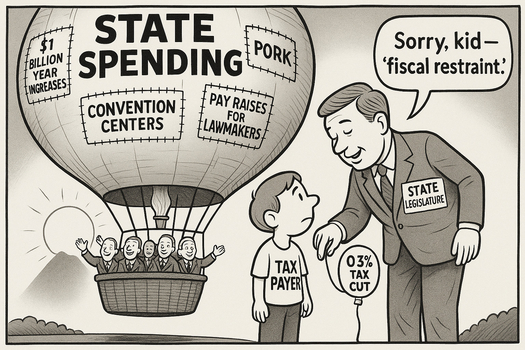
Not that they didn't try. Budgets grew at warp speed, expanding by as much as $1 billion a year. Legislators spent with drunken abandon. There was money for everything, from white-elephant convention centers to the bottomless pit of education "reform," from fat raises for themselves to mammoth severance packages for ousted bureaucrats, from subsidies for millionaire sports-team owners to an endless parade of pork.
Even at their most gluttonous, though, they couldn't consume all the revenue being extracted from taxpayers, who were still paying the "temporary" tax hike. As excess dollars pooled in huge surpluses, they were stashed away in assorted reserve accounts and "rainy day" caches and "transitional escrow funds." Anything, it seemed, was preferable to giving the money — any money — back to the taxpayers.
On Election Day 2000, the taxpayers finally took matters into their own hands and voted overwhelmingly for the tax rollback they had been promised 11 years earlier. Not being greedy, they stretched the reduction to 5 percent over three years. The first cut, to 5.6 percent, kicked in last January. The second cut, to 5.3 percent, is to take effect in January 2002.
But if the Democrats — which is to say, Senate President Tom Birmingham and House Speaker Tom Finneran — have their way, there will be no second cut. Their campaign to "freeze" (read: kill) the tax rollback is in full swing. Members are being lobbied to support a freeze; special interest groups, the ones usually found with their snouts in the state trough, are endorsing the idea. "This is something we are doing with the greatest reluctance," Birmingham said in his smarmy way a few days ago. "But there are times in public life when we have to make difficult decisions."
Birmingham and Finneran can't agree on a state budget, which is now five months overdue. To close the current revenue shortfall, they need only resurrect the $21.5 billion budget that was passed in 2000, but they can't even manage that. Needless to say, it hasn't occurred to them to give back the 8 percent pay raise every legislator received in January. Some "difficult decisions" are too difficult even for these legislative titans.
But prevent you and me from keeping an additional 0.3 percent of our own money next year? Tear up a law that the voters approved in a landslide? Reinforce every stereotype about the greed, arrogance, and contemptibility of state legislators?
Hey, just leave it to them.
Jeff Jacoby is a columnist for The Boston Globe.
-- ## --
Follow Jeff Jacoby on X (aka Twitter).
Discuss his columns on Facebook.
Want to read something different? Sign up for "Arguable," Jeff Jacoby's free weekly newsletter.