





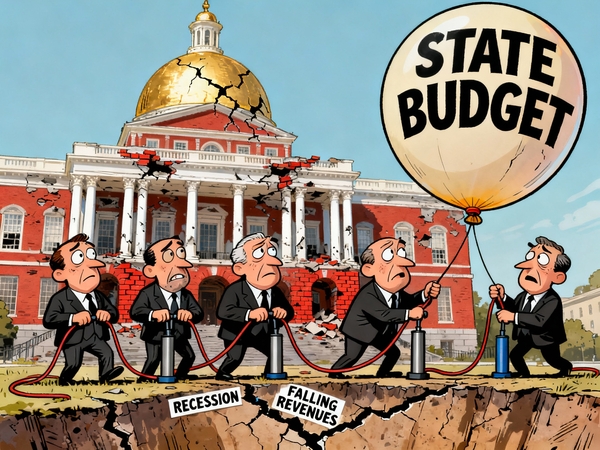
If you don't follow Massachusetts politics, you might imagine that only a dire emergency could be keeping legislators from meeting such a key deadline. In 47 other states, after all, budgets for this fiscal year have been completed. What terrible crisis has so paralyzed Bay State lawmakers that they cannot complete a spending plan that was due more than 3 1/2 months ago?
No crisis at all. The only thing keeping them from doing their job is the disregard they have for the voters who elected them. If there were penalties to pay for missing key deadlines, as there are in real life, legislators might take the budget more seriously. But Massachusetts long ago stopped holding competitive legislative elections, and House and Senate members know that their reelection is more or less assured. With little reason to fear voter reprisals, lawmakers find it easy to blow off their obligations.
To be sure, it makes little difference what 99 percent of the Legislature thinks or does. Decisions are made by just two people: House Speaker Thomas Finneran and Senate President Thomas Birmingham. Each rules his chamber like an autocrat, and the Legislature approves nothing without their blessing. Which means that Beacon Hill will get around to finalizing this year's budget when Finneran and Birmingham want to finalize it, and not a day earlier.
Meanwhile, the gathering recession (and the economic blow that struck on Sept. 11) is taking its toll on Massachusetts. Unemployment is up to 4 percent and is expected to go higher. Sales are down and there is fear they will go lower. For the third month in a row, tax revenues shrunk. In September, the drop was especially steep: $228 million less than the same month a year ago, a 13 percent reduction. The economic quarter that ended on Sept. 30 was the state's worst in more than a decade. And it seems clear that things will get worse before they get better.
So naturally Beacon Hill thinks this is a good time to enlarge its budgets.
Since that is the opposite of what Beacon Hill claims to be doing, some background is in order.
All through the booming '90s, the Massachusetts state budget grew fatter and fatter. Last year was no exception. The fiscal 2001 budget (passed in 2000) totaled $21.5 billion, a $700 million increase over the budget enacted the year before. It marked the ninth consecutive increase in state spending, swelling it far beyond anything Michael Dukakis ever proposed.
This year, despite the obvious weakening of the economy, the governor and Legislature had every intention of continuing their binge. The (unreconciled) budgets passed by the House and Senate in early summer came to roughly $22.9 billion — a jump of $1.4 billion, or 6.5 percent, from the budget passed a year earlier.
Only after Sept. 11 did it finally occur to Beacon Hill's budgeteers that this might not be the best time to be spending at more than twice the rate of inflation. So late last month, amid much talk of "cuts," they let it be known that the final budget — when it shows up — will total $22.6 billion. Their response to falling revenues, in other words, will be to hike the budget by $1 billion instead of $1.4 billion. This is what passes for belt-tightening in the Massachusetts State House.
"Everyone must be prepared," says Finneran, "to make a collective sacrifice." Spare us the unction, Mr. Speaker. It's bad enough that you're jacking up spending at a time when taxpayers are seeing their investments, their savings, and even their jobs vanish. Must you also dissemble?
Speaking of taxpayers, Finneran suggested a few weeks ago that they forgo the rest of the tax cut they voted for last November. In the face of a veto threat by Acting Governor Jane Swift, Finneran now says that talk of killing the rollback of the income tax rate from 5.85 percent of 5 percent is "entirely premature."
But it was outrageous to even propose such a thing. Raising taxes in a weakening economy - which is what halting the scheduled cuts would amount to — would be disastrous. Besides, the state has more than $4 billion stashed away in assorted "rainy day" and trust funds; citizens do not have to be robbed of their tax cut to balance the state's books.
If anything should be sacrosanct, it is the voters' decision last fall. Their vote to lower taxes was preceded by a vigorous statewide debate in which the pros and cons were thoroughly aired and the details widely disseminated. The public overwhelmingly agreed that taxes are too high; that is why they are now gradually being reduced. If spending is also too high, the budget should be reduced as well. Assuming, of course, that there's going to be a budget this year. Is there?
Jeff Jacoby is a columnist for The Boston Globe.
-- ## --
Follow Jeff Jacoby on X (aka Twitter).
Discuss his columns on Facebook.
Want to read something different? Sign up for "Arguable," Jeff Jacoby's free weekly newsletter.