




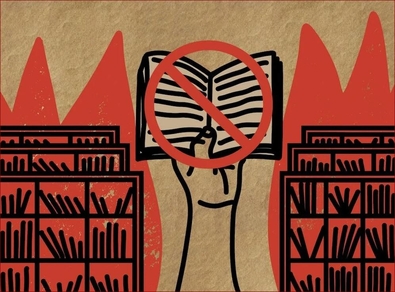
SO YOU'RE proud to be an American? Glad to live in this sweet land of liberty, a country fanatics hate because of its freedom, pluralism, and openness to new ideas? Well, just in time to pop that illusion, the American Library Association is back this week with Banned Books Week, its annual attempt to convince us that censorship is alive and well and eating away at our intellectual right to choose. The Taliban are at the gates, the ALA warns; can book-burning be far behind?
 Not to worry. Your freedom to read isn't under attack. No censors are stalking you, no library is being stripped. On the contrary: Never have more books by more authors on more subjects been more readily available to more people. Americans have things to worry about these days, but book-banning isn't among them.
For a "banned book," it turns out, doesn't mean a book that has been banned. It means a book about which somebody, usually a parent, has raised an objection — typically that it is too violent or sexually explicit or that it is not age-appropriate. The vast majority of these complaints deal with books assigned in school classes or found in school libraries. And as even the ALA acknowledges, the complaints usually go nowhere and the books stay where they are.
In short, the fanatics and book-burners against whom Banned Books Week is meant to keep us vigilant are mostly parents who raise questions about their kids' reading material. In the world according to the American Library Association, moms and dads are the enemy.
And the books this enemy is trying to ban? No. 1 on the ALA's current list is J.K. Rowling's "Harry Potter" series. No. 5 is John Steinbeck's "Of Mice and Men." Number 6 is Maya Angelou's "I Know Why the Caged Bird Sings." Those books can be found in 98 percent of the nation's bookstores and 99 percent of its libraries. They can be bought over the Web, listened to on tape, and read in a host of foreign languages. This is censorship?
Of course not every complaint about a book is reasonable. Parents who want to keep "Huckleberry Finn" and "Native Son" out of students' hands deserve to get short shrift. But not every complaint is unreasonable, either. Some books do contain vile language or graphic sex and violence; some books are inappropriate for younger readers. A parent who asks the local library to limit her 11-year-old's access to "The Turner Diaries" because she doesn't want him reading neo-Nazi literature is hardly a fanatic. Yet the ALA makes no allowance for common sense: Anyone who challenges any book for any reason is "banning books."
Unless they work for a library or bookstore, that is. Nowhere does the ALA warn against, say, the bookstore buyer who refuses to stock a book because he doesn't like its message or the librarian who suppresses works by authors he disagrees with. "The selection criteria that librarians use may not always be what everybody wants," says spokeswoman Larra Clark. "I don't see that it's a real problem."
She ought to meet Tom Spence. He is the president of Spence Publishing Company, a small press dedicated to books on cultural and social issues written from a conservative outlook. Among its current offerings are A.J. Conyers's history of toleration, "The Long Truce"; "Shows About Nothing," a study of film and TV by Boston College philosopher Thomas Hibbs; David Horowitz's bracing polemic on racial politics, "Hating Whitey"; and "Love and Economics: Why the Laissez-Faire Family Doesn't Work," by the economist (and Forbes columnist) Jennifer Roback Morse. Serious books by serious authors, in other words, and presumably of interest to serious bookstores and libraries.
But consider some of the responses Spence received after mailing his Spring 2001 catalog.
From the director of a state university bookstore:
I wish to be REMOVED from your mailing list. I find some of your titles to be offensive and outright simple minded. I will not sell your titles in any of my stores so please do not promote these ridiculous books to me!
From the manager at a Berkeley, Calif., bookstore:
Please take me off your mailing list. . . . We do NOT sell fascist publications.
From the books editor at a major Midwestern daily, after receiving a review copy of "Love and Economics":
Please take me off of your contact list. If you want to reach a narrowminded audience, try the small-town rags.
Then there was the public library in West Haven, Conn., that ordered Spence not to send any more catalogs. When the publisher called to ask why, the librarian hung up on him — four times.
Bookstores, libraries, and newspapers can't acquire or review every new book, of course. But should entire catalogs be blackballed or publishers insulted because of the ideological prejudice of the librarian or books editor? Isn't that a form of "book banning?" Maybe the ALA ought to take a closer look.
Jeff Jacoby is a columnist for The Boston Globe.
-- ## --
Follow Jeff Jacoby on X (aka Twitter).
Discuss his columns on Facebook.
Want to read something different? Sign up for "Arguable," Jeff Jacoby's free weekly newsletter.