






AMONG THE most audacious philosophical assertions in Western history, one memorized by innumerable American schoolchildren, is the preamble to Thomas Jefferson's Declaration of Independence: "We hold these truths to be self-evident, that all men are created equal, that they are endowed by their Creator with certain unalienable Rights..."
Accustomed as we are to the poetry and music of Jefferson's words, too many Americans are apt to forget — or perhaps never to have learned in the first place — just how revolutionary their message was.
Consider some remarks made by Senator Tim Kaine, a Virginia Democrat, during a hearing on Capitol Hill last week.
On Thursday, the Senate Foreign Relations Committee took up the nomination of Riley Barnes, President Trump's choice for assistant secretary of state for democracy, human rights, and labor. In his prepared testimony, Barnes quoted something Secretary of State Marco Rubio told State Department employees earlier this year: that America is founded on the powerful principle "that all men are created equal, because our rights come from God our Creator – not from our laws, not from our governments."
When it was Kaine's turn to question Riley, he vigorously disputed the nominee's words.
"The notion that rights don't come from laws and don't come from the government but come from the Creator — that's what the Iranian government believes," Kaine contended.
"It's a theocratic regime that bases its rule on Sharia law ... and they do it because they believe that they understand what natural rights are from their Creator. So the statement that our rights do not come from our laws or our governments is extremely troubling."
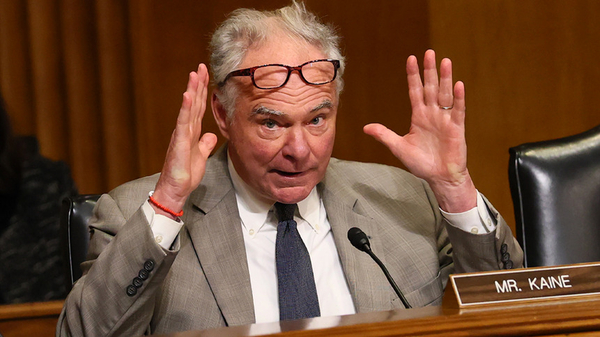 Senator Tim Kaine, Democrat of Virginia, rebuked a nominee at a confirmation hearing before the Senate Foreign Relations Committee for saying that 'Our rights come from God our Creator' not from government. |
What Kaine disdained as "extremely troubling" was, in fact, the very premise of American independence: that human beings are endowed by their Creator with rights beyond the reach of governments to give or take away. That conviction was the moral engine of 1776: Liberty is not granted by legislatures, executives, or kings but is inherent in the human condition. The Declaration insists that all people are entitled to life, liberty, and the pursuit of happiness — entitled to them unalienably — precisely because they derive from a source beyond the reach of parliaments or princes. For the 56 men who pledged their lives, their fortunes, and their sacred honor to the defense of those rights, this was the axiom that justified revolution.
America's greatest leaders never lost sight of it.
In 1775, even before the Declaration was drafted, Alexander Hamilton had written that the "sacred rights of mankind are not to be rummaged for among old parchments or musty records," but are "written, as with a sunbeam ... by the hand of the divinity itself." Abraham Lincoln in 1858 eloquently summarized it as the Declaration's "enlightened belief" that "nothing stamped with the Divine image and likeness was sent into the world to be trodden on and degraded and imbruted by its fellows."
Just over a century later, John F. Kennedy would emphasize the same point in his stirring inaugural address: "The rights of man come not from the generosity of the state but from the hand of God."
And Ronald Reagan, celebrating his first Independence Day as president in 1981, likewise reaffirmed that principle: "Let the Fourth of July always be a reminder that here in this land, for the first time, it was decided that man is born with certain God-given rights; that government is only a convenience created and managed by the people, with no powers of its own except those voluntarily granted to it by the people. We sometimes forget that great truth, and we never should."
Plainly, the conviction that human rights come from God and not from governments is as foundational to the American story as any belief can be. So what does it mean when, in 2025, a senator from Jefferson's own Virginia leaps unhesitatingly to attack it?
Well, one thing it must mean is that Jefferson was wrong to imagine that the source of our unalienable rights was "self-evident." Clearly it isn't. Otherwise, how could a sitting US senator — in fact, the Democratic nominee for vice president in 2016 — recoil in dismay at hearing that view expressed?
In declaring their independence from the British crown, the American colonists were planting a radical flag: Government does not mint rights, it merely secures them. Yet again and again in American history, the opposite view reemerges — that our liberties are permissions dispensed by the state. When Senator Kaine recoiled from Jefferson's words about rights endowed by a Creator, he was channeling a temptation as old as politics itself: to make government the supreme source of human freedom. That temptation led kings to justify monarchy, slaveholders to defend bondage, autocrats to silence dissent. In every age, liberty is imperiled less by outright denial than by the slow creep of an idea: What government confers, government may also revoke.
Kaine went even further. What especially seemed to horrify him was the invocation of God in connection with fundamental rights. That, he intoned ominously, is "what the Iranian government believes." It's true that tyrannies sometimes cloak themselves in religious garb: the ayatollahs in Tehran, the zealots of ISIS, the Taliban in Afghanistan, the Islamist fanatics of Al Qaeda and Hamas. But if the senator imagines that pious rhetoric is the chief danger to liberty, he is profoundly mistaken.
The bloodiest assaults on human rights in modern history were launched not in the name of God but in defiance of God. It was the militantly atheist regimes of the twentieth century — Lenin and Stalin's Soviet Union, Hitler's Germany, Mao's China, Castro's Cuba, Pol Pot's Cambodia — that murdered scores of millions, crushed consciences, and extinguished liberty on a colossal scale. They explicitly denied that all men are created equal, let alone that they are endowed by a Creator with inherent rights. And in that denial lay the logic that human beings could be enslaved, silenced, or slaughtered whenever the state decreed.
Far from being the principal enemies of freedom in American history, men and women of faith have again and again been its most devoted champions. In the 19th century, it was religious conviction that fueled the abolitionist movements in Britain and America, inspiring figures like William Wilberforce, Frederick Douglass, and Harriet Beecher Stowe. In the 20th century, it was Black preachers and church communities that sustained the civil rights movement, with Martin Luther King Jr. proclaiming from the steps of the Lincoln Memorial that the Declaration of Independence was a "promissory note" of God-given rights still to be redeemed.
A key theme of Alexis de Tocqueville's monumental study, "Democracy in America," was how essential religion was to the health of democratic liberty in the United States. The French statesman and social philosopher called religion the "first of [America's] political institutions." He did not know, he said, "whether all Americans have a sincere faith in their religion — for who can search the human heart? — but I am certain that they hold it to be indispensable to the maintenance of republican institutions."
That a senator from Jefferson's Virginia hears the word "God" and thinks only of theocratic despotism is not just a mistake. It reflects a grievous distortion of the American story, which from the Mayflower Compact to Washington's Farewell Address, from the motto on our currency to the preambles of every state constitution, has linked religion and liberty as allies. To associate "Creator" with tyranny is to forget that America's greatest struggles for freedom were led by those whose religious faith was central to their lives.
To be fair, Senator Kaine isn't the only leader adrift on the meaning of America's birth certificate. Asked recently to summarize the message of the Declaration of Independence, President Trump replied that it was about "unity and love and respect." Those are pleasant sentiments, but they have nothing to do with what Jefferson actually wrote. The Declaration did not announce that Americans were bound together by feelings of affection. It declared something far more revolutionary: that human beings possess inherent rights by virtue of having been created by God and that the primary function of government is to ensure those rights.
Kaine's confusion didn't receive nearly the attention it deserved. Conservative outlets seized on his remarks and clips posted on right-leaning social media accounts went viral. But across the so-called mainstream press — The New York Times, The Washington Post, Politico, CBS News, Bloomberg, the Globe — there was nothing. A senator's harsh scorn for the Declaration's central premise attracted no attention. That reflected not so much an editorial bias as a broad cultural blind spot: an erosion of civic memory so deep that even a denial of Jefferson's core teaching failed to stir comment.
The American Revolution began with the audacious claim that rights are not favors to be distributed by the state but the birthright of every human being. A quarter of a millennium later, that claim still hangs in the balance. If today's leaders cannot articulate it — or worse, if they vehemently deny it — the rest of us ought to demand that they be schooled . . . or be replaced.
America forgets the source of its rights at its peril. Once liberty is treated as a grant from the state, it can be curtailed or revoked at the state's whim. That is how free nations grow unfree.
* * * * * * * * * * * * * * * * * * * * * * * * * * * * * * * * * * * * * * * * * * * * * * *
What I Wrote Then
24 years ago on the op-ed page
From "Our enemies meant what they said," Sept. 13, 2001:
Now that it has happened to us, the White House is not calling for "restraint." The State Department is not concerned about "escalating the cycle of violence." There are no editorials imploring the parties to conduct a "peace process" and "sit down at the negotiating table."
Now that it has happened to us, the TV anchors are calling them terrorists, not "militants" or "activists." Washington is not being warned to avoid a "provocative" response, or cautioned against retaliation that is "excessive and disproportionate."
Now that it has happened to us, our eyes have finally opened. Now at last we understand that there is a war underway — and we are in it. For years we have acted as if the front line were elsewhere, and as if our job was to watch from the sidelines and make sure our friends didn't defend themselves too aggressively. Now, after the worst massacre in US history, only the willfully blind can fail to see that the front line is here.
* * * * * * * * * * * * * * * * * * * * * * * * * * * * * * * * * * * * * * * * * * * * * * *
The Last Line
"'I feel fine,' she said. 'There's nothing wrong with me. I feel fine.'" — Ernest Hemingway, "Hills Like White Elephants" (1927)
* * * * * * * * * * * * * * * * * * * * * * * * * * * * * * * * * * * * * * * * * * * * * * *
Jeff Jacoby is a columnist for The Boston Globe.
-- ## --
Follow Jeff Jacoby on X (aka Twitter).
Discuss his columns on Facebook.
Want to read something different? Sign up for "Arguable," Jeff Jacoby's free weekly newsletter.