





He defined it as "the acute onset of paranoia in otherwise normal people in reaction to the policies, the presidency — nay, the very existence — of George W. Bush." It was a memorable phrase, and it fit those who openly reveled in their loathing of the president, routinely likened him to Adolf Hitler, or hawked T-shirts urging his assassination.
Krauthammer was being arch, of course. But he was also making a serious point about the wholesale loss of proportion that can drive partisans to abandon judgment. Bush "derangement" manifested itself in outrageous libels like Senator Ted Kennedy's claim that the Iraq War was a "fraud" Bush had "cooked up in Texas" for political gain or the "interesting theory" proffered by Vermont Governor Howard Dean that Bush had been tipped off by Saudi Arabia about the 9/11 terror attacks. An article in The New Republic, headlined "The Case for Bush Hatred," began: "I hate President George W. Bush. There, I said it."
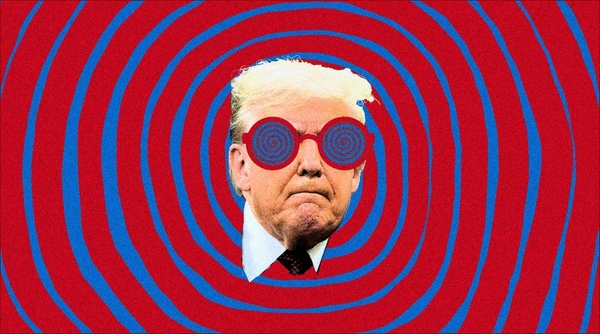
Two decades on, Krauthammer's coinage has been appropriated, rebranded, and defined down — way down. "Trump Derangement Syndrome" is now flung at anyone who objects to President Trump's conduct or opposes his policies. The term is no longer reserved for over-the-top expressions of revulsion — like actor Robert De Niro using a televised appearance at the Tony Awards to proclaim "F*** Trump" and being rewarded with a standing ovation. Or like Kamala Harris declaring on CNN that Trump was a "fascist" who expected US military leaders to be as blindly loyal to him as "Hitler's generals."
No — today "Trump Derangement Syndrome" is used as an all-purpose put-down to deride any Trump critics, including those who stick to serious, fact-based analysis. I've lost count of all the times I've been diagnosed with TDS after writing that a given Trump policy is wrong, counterproductive, or unlawful.
The word "syndrome" notwithstanding, this is merely political trash talk, popularized by Trump and his allies as a way to wave off criticism without having to engage it. Instead of refuting arguments or defending policy, the magic letters "TDS" turn disagreement into proof of mental defect.
Yet if "derangement" means the loss of proportion and judgment Krauthammer was getting at, then the most severe cases aren't among Trump's critics. They're in the ranks of his most ardent loyalists.
The real Trump Derangement Syndrome shows up in three telltale symptoms.
First is the cult-like worship that treats Trump as infallible — his acolytes profess adoration not only for what he does, but for whatever could flow from him.
Emblematic of that mindset are the "Trump Was Right About Everything!" baseball caps, which the president himself prominently displayed in the Oval Office in February 2025. The caps are intended less as a joke than as a badge of faith. They echo Trump's infamous boast about being able to "stand in the middle of Fifth Avenue and shoot somebody and [not] lose any voters." For some in his base, there is literally nothing he could do that would shake their devotion. The more outlandish the president's deeds or words, the more his enthusiasts praise his strategic genius and his mastery of four-dimensional chess.
Second is the abandonment of principles that once seemed non-negotiable. Conservatives and Republicans who used to champion free trade now cheer Trump's tariffs. Those who formerly prized NATO as a linchpin of global security today nod in agreement when Trump disparages America's allies. Republicans once railed against Barack Obama's and Joe Biden's "pen-and-phone" executive actions, yet they applaud as Trump goes far beyond his predecessors in ruling by executive decree. To those afflicted with TDS, principles are expendable and whatever Trump says or does must be defended. Yesterday's bedrock conviction becomes today's expendable talking point.
Third is the unsettling delight so many supporters take in Trump's most outrageous behavior — a kind of giddy worship that equates offensiveness with authenticity. Such brazenness has been a hallmark of his political career — from mocking John McCain's Vietnam War heroism to charging undocumented immigrants with "poisoning the blood of our country" to calling for "one really violent day" to end property crime. The more extreme the rhetoric, the more MAGA true believers praised it — as if outrage were the highest form of loyalty. The Trump hard core doesn't just tolerate or excuse infamy; many revel in it.
Meanwhile, they reflexively use "TDS!" as a go-to put-down for anything from mild disagreement to serious moral critique, framing opposition not as argument but as pathology — an easy, cheap discredit. Yes, plenty of Trump-haters go overboard — but in MAGA circles, the "TDS" tag is sprayed far wider, hitting thoughtful critics just as readily as the genuinely unhinged.
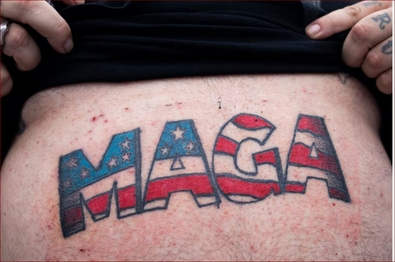 A man with a MAGA tattoo on his stomach attended a rally in Warren, Mich., to mark President Trump's 100th day in office on April 29. |
What is truly alarming is how some have sought to legalize that insult by casting dissent as disease. In Minnesota this spring, five Republican senators proposed a bill that would redefine "Trump Derangement Syndrome" as an official mental illness under state law. And on Capitol Hill, Representative Warren Davidson, an Ohio Republican, has introduced the "Trump Derangement Syndrome Research Act," which would direct the National Institutes of Health to study this "toxic state of mind." Treating political disagreement as a clinical condition isn't persuasion — it's repression.
Krauthammer's original point in 2003 was that derangement is the breakdown of proportion and prudence. That breakdown isn't found among critics who quote Trump accurately and challenge his claims. The most alarming political derangement today affects those who cannot conceive that there are legitimate reasons to be appalled by the president, and so explain anti-Trump dissent as a sign of mental weakness. If reason is the measure, then those who shout "TDS!" the loudest are the ones most in need of treatment.
Jeff Jacoby is a columnist for The Boston Globe.
-- ## --
Follow Jeff Jacoby on X (aka Twitter).
Discuss his columns on Facebook.
Want to read something different? Sign up for "Arguable," Jeff Jacoby's free weekly newsletter.