





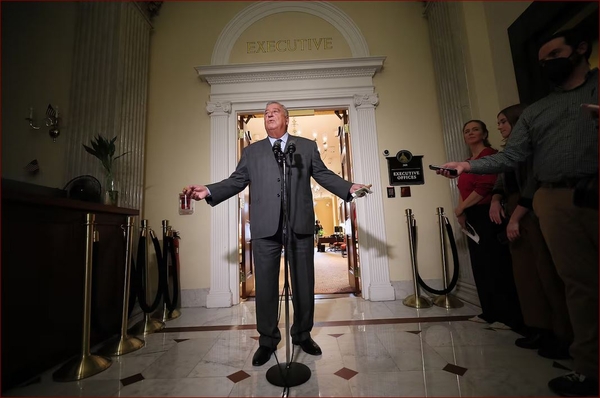
 House Speaker Ron Mariano's annual compensation is more than $224,000, over half of which comes from his "leadership stipend." |
Ron Mariano, the speaker of the Massachusetts House of Representatives, was first elected to the Legislature in a 1991 special election and, beginning the following year, has been returned to office every two years since. It probably won't surprise you to learn that he has never disparaged the competence of the voters to pick him as their state representative.
But when it comes to making a judgment about his own perks and pay — or indeed about any other public policy — Mariano's confidence in the voters' good sense disappears.
Last week was the deadline to submit petitions to put a ballot question before voters in the 2026 state election. Dozens of proposed laws were filed with Attorney General Andrea Campbell's office, including two initiatives to rein in the "leadership stipends" paid to most state legislators. As the Globe has reported, those stipends are little more than a device to fatten legislative pay while concentrating ever more power in the hands of Mariano and his counterpart, Senate President Karen Spilka.
The filing of the ballot petitions embodies the very reason the initiative-and-referendum process was created: so that when Beacon Hill refuses to do its job or devotes more energy to self-dealing than to serving the public, citizens still have recourse.
Mariano, however, is offended that voters should have such authority. Commenting last week on the sheaf of petitions filed with the AG's office, the speaker derided ballot measures as the instruments of "well-financed special interest groups," complained that it's "way too easy" to qualify them, and sneered that voter-written laws "have holes in them."
In Mariano's view, voters can be trusted to choose politicians but not to choose policies.
The bid to curb Beacon Hill's notorious leadership stipends, which augment the salaries of three-quarters of the state legislators by thousands of dollars each, was launched by the Coalition to Reform Our Legislature, a bipartisan alliance of liberals and conservatives fed up with the lack of integrity, transparency, and accountability on Beacon Hill. One of the petitions would eliminate the stipends altogether. A second would sharply reduce their number and value, and end the practice of paying extra money to "leaders" of committees that never meet or hold hearings.
Among the other initiatives submitted to the AG were proposals to reimpose rent control in Massachusetts, to switch to nonpartisan primary elections, and to apply the state's public records law to the governor and the Legislature. Secretary of State William Galvin filed an initiative to allow would-be voters to register at the polls on Election Day. A coalition of business groups submitted a petition to reduce the state income tax rate from 5 percent to 4 percent. And several environmental organizations want sales taxes collected on sporting goods to be earmarked for conservation projects.
Most of these measures won't go the distance. The initiative petition process is a grueling slog, not a lark. Proponents must survive legal vetting and clear two separate rounds of signature gathering. For 2026, the first round alone requires 74,574 certified signatures by early December; if the Legislature then sits on the proposal, supporters must collect another 12,429 by the following summer. Waging a ballot campaign demands considerable legwork, commitment, funding, and persuasiveness. "Way too easy" this is not.
Mariano's allergy to ballot questions is not new. He has previously waved off citizen lawmaking as messy and prone to unintended consequences. Obviously some citizen-initiated laws can be imperfect. But those that succeed have almost invariably been subjected to more careful vetting, more thorough debate, and more transparent coverage than bills approved in the Legislature.
And then there is the problem of self-interest. Mariano is a chief beneficiary of the very compensation structure the Coalition to Reform Our Legislature seeks to check. Following the latest adjustments, his total annual pay tops $224,000 — and the leadership stipend alone comes to nearly $120,000. It's no mystery why the speaker would rather keep decisions about such pay behind closed doors, beyond public records law, and safely insulated from a public vote. But what serves his self-interest is exactly what erodes the public's. In a state whose Legislature is routinely ranked the most secretive in the nation, shielding lawmakers' perks from voter oversight isn't just bad optics — it's bad governance.
And it lays bare Mariano's unprincipled double standard. When voters keep returning him to office, they are wise, discerning, and trustworthy. But when those same voters ask for a say on public policy, they are gullible pawns of "special interests" whose ideas aren't worth putting to a vote.
That's the arrogance the initiative process was designed to check. Citizens in Massachusetts don't get to legislate every day; they get the chance only after clearing high legal and logistical hurdles, and only when a large number of their neighbors agree. If Mariano truly believed in the voters he's been happy to rely on for three decades, he'd welcome their voice in the policies that govern them. If he doesn't, he should at least have the candor to admit it: He trusts the public only on one ballot question — the one with his name on it.
Jeff Jacoby is a columnist for The Boston Globe.
-- ## --
Follow Jeff Jacoby on X (aka Twitter).
Discuss his columns on Facebook.
Want to read something different? Sign up for "Arguable," Jeff Jacoby's free weekly newsletter.