





Second of two columns.
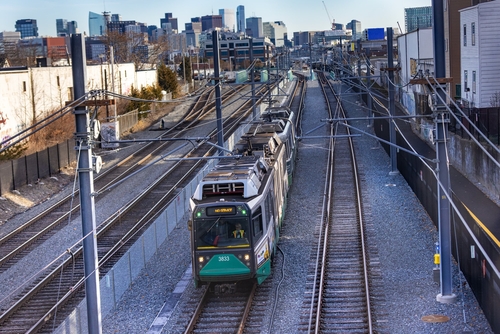 The MBTA's Red, Blue, Orange, and Green lines will become fare-free, in exchange for cracking down on labor union contracts and raising parking rates at the T garages. |
The newly appointed transportation czar resumes his inaugural remarks . . .
It will take more than deregulating taxis, and charging tolls on all major highways to bring order and fairness to our transportation system, of course. I will outline as many of the coming changes as I can. But first let me clarify an earlier point.
Turning the highways into toll roads will not tie up traffic, since no one will have to stop to pay tolls. As cars enter and exit the highway, they will pass under a span that will communicate with the transponder on their windshield and automatically assess the applicable toll. For cars without transponders, an imaging system will photograph the license number and a bill will be sent to the owner of record. Science fiction? Not at all. This technology is already in use, as those of you who have driven Toronto's Highway 407 can attest.
Technology will make drivers' lives easier in other ways. For example, I will abolish the yearly automobile inspection, a costly and largely pointless ritual. Why must every car owner be put through the hassle of an emissions test when only a small minority of cars fail? Far better to use remote sensing to check emissions right on the road. As cars pass an infrared sensor, their tailpipe exhaust will be instantly analyzed. Those that don't meet clean-air standards will be identified and the owner will have 30 days to get his vehicle repaired. Those that are clean won't even have to slow down.
Other changes: The obsolete federal caps that limit the number of parking spaces in cities like Boston will be lifted. Such caps may have made sense 25 years ago, when auto exhaust was dirtier. Today, they serve only to make in-town parking expensive and frustrating. Thousands of new parking spaces, privately built and managed in spacious un der ground garages, are long overdue.
New parking spaces are needed outside city limits, too. I intend to expand the suburban park-and-ride lots that feed bus, rail, and MBTA lines and to build new ones where reasonable. But I also intend to make these facilities pay for themselves, which means that rates at many of them are going to rise. In other words, no more $4-a-day parking at the Alewife garage.
Which brings me to the subject of mass transit.
I am not one of those who believes that more mass transit would be a panacea. I do recognize, though, that for many people it is essential, and that greater use of transit will ease the pressure on motorists. But if we are to have mass transit, there is no excuse for not managing it competently. What is needed is a mix of strategies: more public funding in some cases, privatization in others; a willingness to build when it makes sense to do so — and to pull the plug on new projects when it doesn't.
Some specifics:
As soon as possible, I plan to make the MBTA's Red, Blue, Orange, and Green lines fare-free, and to increase the length and frequency of the trains, especially during rush hour. The loss of fare revenue will pinch, but less than you might think — fares pay for only a fraction of of the T's actual costs — and it is a price worth paying in exchange for the improvement in service and the increase in ridership.
Don't get the wrong idea: I do not propose to squander the taxpayers' money. The T now loses some $800 million each year; cutting those losses is very high on my agenda. For that reason, it is vital that we rationalize the T's operations, especially its ruinous labor policies. From the rule against hiring part-timers to the excessive salaries of bus drivers, the system is crying out to be reformed. I will heed that cry.
I will also save money by contracting out most of the MBTA's bus lines. The experience of other cities — San Diego, Las Vegas, Indianapolis — makes it clear that when it is done right, privatization means better bus service at a lower cost. Of course this will mean an end to the odious Pacheco law, which has done such harm here in Massachusetts by shielding public services from private-sector competition.
Amtrak is another disgrace. Its infrastructure is antiquated, its losses are massive, and its work quality is abysmal — just look at the mess it has made of the T's commuter rail. It is safe to say Amtrak will never improve so long as the government maintains its monopoly on rail service. Which is why, after bringing the system's track up to 21st century standards, we will auction off its routes to private-sector operators.
Finally, a few words — a very few words — about air travel. If Heathrow and Gatwick can flourish as private facilities, there is no reason for Logan Airport to remain a government operation. It will be privatized. The ancient debate over landing fees will end at last, and a congestion-pricing system will be imposed forthwith. The debate over a new runway will end, too: The runway will be built, but airlines will only be permitted to operate planes that meet the most stringent noise-suppression requirements.
With that, I'll stop. Thank you very much for your attention. Are there any questions?
Jeff Jacoby is a columnist for The Boston Globe.
-- ## --
Follow Jeff Jacoby on X (aka Twitter).
Discuss his columns on Facebook.
Want to read something different? Sign up for "Arguable," Jeff Jacoby's free weekly newsletter.