






HEADING INTO the Fourth of July, headlines drew attention to what appears to be a disturbing trend: a marked decline in the number of adults who say they are proud to be Americans.
According to new Gallup polling, only 58 percent of Americans describe themselves as "extremely" (41 percent) or "very" (17 percent) proud to be an American — an all-time low. The plunge in pride is concentrated among Democrats and independents. While 62 percent of Democrats called themselves proud to be Americans last year, only 36 percent feel that way now. The drop among independents, from 60 percent to 53 percent, is less steep. But for both groups, pride in their national identity is now lower than it has ever been.
Meanwhile, according to a separate survey conducted by the Republican polling firm National Research, Inc., 91 percent of self-identified Republicans call themselves "patriots," compared to just 50 percent of Democrats. Adam Geller, the founder of National Research and a GOP strategist who worked for Donald Trump's 2016 campaign, told the New York Post that while the results may stem in part from "a little leftover saltiness" from the 2024 election, "we need to have a country where, even if you don't love the president, you're still proud to be an American — you still hold those values."
Predictably, many on the right have seized on the numbers — sometimes with undisguised partisan loathing — as evidence of Democrats' alienation from the nation. In a USA Today column — headline: "I'm proud to be an American. If you don't like it here, leave" — Nicole Russell urges liberals who don't appreciate the blessings of life in America to self-deport.
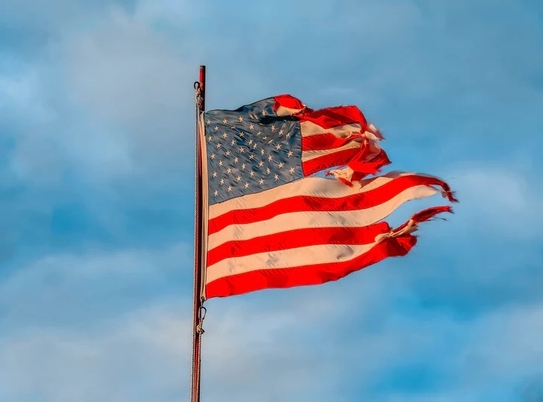 Uncritical pride is not the mark of a healthy patriotism. |
I'll take a pass on jumping into the left-vs.-right ideological scuffle (at least this time around). Instead I want to explore a different question: What exactly are we measuring when we ask people whether they are "proud to be an American"?
The wording of that question has always struck me as awkward and ambiguous. It confuses very different feelings — gratitude, approval, and identity — by jumbling them into a single, emotionally charged term.
The phrase "proud to be an American" has been a staple of America's civic vocabulary for decades. It was famously enshrined in Lee Greenwood's 1984 anthem, "God Bless the USA," which became a cultural touchstone after it was featured in a film about Ronald Reagan at that year's Republican National Convention. Its popularity surged again in the wake of the 9/11 terrorist attacks, when Greenwood performed it at Yankee Stadium during the World Series.
Gallup has been asking the question in essentially the same form for over two decades, making it a useful barometer of national sentiment. And yet, looked at closely, the question is clumsy. Respondents aren't being asked about their pride in America, or America's achievements, or America's values. The question Gallup keeps polling is about people's pride in being American. But what does it mean to be proud of something you didn't choose or achieve?
Most Americans were born in this country, which is no more of an accomplishment than being born in February. The case is different for naturalized immigrants, who become Americans by choice, often devoting much time, effort, and commitment to do so. For them, "being an American" is indeed an achievement for which they're entitled to feel proud. That is because pride, to be meaningful, requires agency: You are entitled to be proud of the things you have done, the learning you have acquired, the contributions you have made — but not of mere accidents of birth you had no say in.
What makes far more sense, in this context, is to ask about gratitude. Americans can and should feel grateful for the freedoms, opportunities, and protections afforded to them by virtue of living in this country. Similarly, Americans can and should express admiration for what their country stands for, or what it has achieved, without reducing that feeling to shallow self-congratulation for being born here.
When Gallup, Pew, or other pollsters ask, "Are you proud to be an American?" what they are really trying to capture, it seems to me, is not so much pride as attachment. The question functions as a proxy for loyalty and belonging, for emotional identification with the nation. Respondents aren't being asked about status but about solidarity. What is being measured is a kind of affective nationalism: Do you feel positively about being an American? Do you embrace that identity in an era when many feel disillusioned or alienated from their government and fellow citizens?
The question is slippery. It allows critics to pounce on a decline in "pride" as evidence of disloyalty or lack of patriotism. And it invites supporters to wave the flag without reckoning seriously with what pride in being an American should actually entail. To be sure, there are certainly Americans who loathe their country and don't hesitate to show it. But I would guess that a high percentage of those who say "No" when asked if they are proud to be an American do love their country but are ashamed or outraged by what is happening in it.
Uncritical pride is not the mark of a healthy patriotism. The British writer G.K. Chesterton warned against just such confusion when he observed: "'My country, right or wrong,' is a thing that no patriot would think of saying. It is like saying, 'My mother, drunk or sober.'" Chesterton's point was not that love of country is bad, but that love becomes blind — and ultimately dangerous — if it demands we approve of everything our nation does, no matter how unjust or misguided.
The German-born US Senator Carl Schurz, an immigrant, a reformer, and a brilliant orator who rose to one of the highest offices in the land, put the matter more constructively: "My country, right or wrong; if right, to be kept right; and if wrong, to be set right." His formulation captures the essence of a mature patriotism — one that loves the country enough to celebrate its virtues and also enough to demand better when it falls short.
The decline in "pride to be an American" doesn't necessarily mean Americans are growing less patriotic. It more likely reflects frustration with the nation's faults and with the political leadership that enables them. As the plunge in pride among Democrats indicates, it is clearly bound up with partisan antipathy for the Trump administration.
It is also generational: Young Americans of every partisan stripe — Democratic, Republican, and independent — express pride in being American at lower rates than their older counterparts. Does that mean they don't care about their country? Or does it signal a deeper moral engagement with what they believe America ought to be?
It would be more illuminating — and less inflammatory — if pollsters distinguished between these different sentiments. Instead of asking simply, "Are you proud to be an American?", why not ask:
- Are you grateful to be an American?
- Are you proud of what America stands for?
- Are you proud of what America has done in the past year?
- Do you feel attached to or alienated from American identity?
Each of those questions measures something real and distinct — gratitude for circumstances, embrace of values, approval of conduct, and emotional belonging. Lumping them all into a single catchphrase encourages people to speak in clichés rather than grapple candidly with the complexity of their feelings about their country.
The simple question has persisted over time in part because it's familiar and easy to track and in part because Americans have been conditioned to respond to it in a certain way. The Greenwood song is still sung, the flag still waved, and the phrase "proud to be an American" still used as a kind of civic password, even when many who say it harbor deep reservations about the country's direction. And for those who refuse to say it, the headlines frame them as outsiders, ungrateful or disloyal, even when their criticism is rooted in love of country and a desire to see it live up to its promise.
Patriotism ought to be more than a reflexive cheer or a performative protest. We can express pride in our ideals without ignoring the ways we have betrayed them. We can love our country without idolizing it, and criticize America without abandoning it. What if we stopped asking people whether they're proud to be Americans, and started asking instead what they're doing to make America a country worth being proud of?
* * * * * * * * * * * * * * * * * * * * * * * * * * * * * * * * * * * * * * * * * * * * * * *
What I Wrote Then
24 years ago on the op-ed page
From "Do these cabbies look like bigots?," July 12, 2001:
How easy it is to beat up on nervous cabdrivers and accuse them of bigotry. How hard to do what they do daily: pick up 30 or 40 strangers and go wherever they say, never knowing in advance if they are going to pay you or stiff you – or shoot you. And to do it for 10 or 12 hours at a stretch, all to earn crummy wages out of which, like a modern sharecropper, you have to pay steep lease rates (or make hefty monthly medallion payments), in addition to covering the daily expenses of keeping the car running.
It takes real powers of imagination to believe that anyone who works as hard as most cabbies do is going to turn up his nose at a paying customer because he doesn't like the color of the guy's skin. Especially when it's the same color as his own.
* * * * * * * * * * * * * * * * * * * * * * * * * * * * * * * * * * * * * * * * * * * * * * *
The Last Line
"Whereof one cannot speak, thereof one must be silent." — Ludwig Wittgenstein, Tractatus Logico-Philosophicus (1922)
* * * * * * * * * * * * * * * * * * * * * * * * * * * * * * * * * * * * * * * * * * * * * * *
Jeff Jacoby is a columnist for The Boston Globe.
-- ## --
Follow Jeff Jacoby on X (aka Twitter).
Discuss his columns on Facebook.
Want to read something different? Sign up for "Arguable," Jeff Jacoby's free weekly newsletter.