





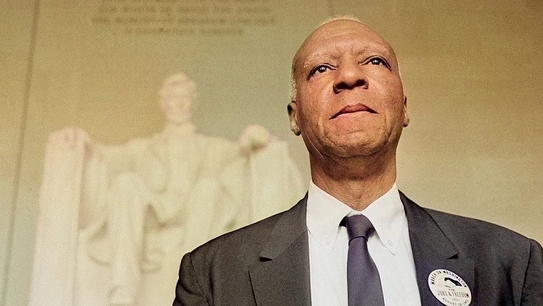
 In 1941, A. Philip Randolph and his Pullman Porters union demanded not racial preferences but "the abrogation of every law which makes a distinction . . . based on religion, creed, color, or national origin." |
ONCE COLORBLINDNESS was synonymous with civil rights. The pioneers in the fight to abolish Jim Crow took as their inspiration Justice John Harlan's great dissent in Plessy v. Ferguson. "Our Constitution is colorblind," Harlan had written, "and neither knows nor tolerates classes among citizens."
That was how civil rights leaders used to sound. In 1941, A. Philip Randolph, the head of the Pullman Porters union, threatened a mass march on Washington. What he and his followers wanted, he said, was "the abrogation of every law which makes a distinction in treatment between citizens based on religion, creed, color, or national origin." Seven years later, Thurgood Marshall's brief for the NAACP in Sipuel v. University of Oklahoma argued that "classifications and distinctions based on race or color have no moral or legal validity in our society."
Sadly, today's civil rights establishment clamors not for color-blindness, but for its opposite: affirmative action, racial preferences, minority set-asides. In another era, the Klan would have been the most vehement foe of laws, like California's Proposition 209, that bar states from granting or denying benefits on the basis of race. Now such laws are more likely to be savaged by the NAACP or Jesse Jackson.
But where those "leaders" lead, Americans no longer follow. Despite furious campaigns against them, Prop 209 (and I-200 in Washington state) prevailed. Florida and Texas have stopped using overt racial criteria in state college admissions. Ordinary citizens — contractors, parents, municipal employees — are increasingly willing to challenge quotas and set-asides in court. It is hard to shake the feeling that the public is fed up with being sorted by color. And to judge from a trio of new polls, that dissatisfaction goes deeper than most of us had known.
In mid-April, a survey on Connecticut's public campuses found that faculty members were opposed — overwhelmingly opposed — to taking race or gender into account in hiring and admissions. Professors at the University of Connecticut disapproved of preferences in faculty hiring by a ratio of 2 to 1. At Connecticut State University, the ratio was 3 to 1. At Connecticut's community colleges, 5 to 1. The faculty opposed preferences in admissions by similar margins.
The poll was commissioned by the Connecticut Association of Scholars. It was conducted by the University of Connecticut's own highly regarded Center for Survey Research and Analysis. If this is how academics in the liberal Northeast feel about affirmative action, what must the rest of the country be thinking?
On the same day the Connecticut poll was issued, the Foundation for Academic Standards & Tradition released the results of a far more comprehensive campus survey. According to a Zogby International poll of college students nationwide, large majorities line up against racial preferences and quotas. Asked whether they agree or disagree that "schools should give minority students preference in the admissions process," 77.3 percent disagreed. Students in every category opposed affirmative action: whites, 79.5 percent; blacks, 51.9 percent; Hispanics, 71.4 percent; Asians, 78.1 percent; others, 78.1 percent.
However the question was framed, students replied that affirmative action is anathema. Asked whether it is unfair to lower entrance requirements for some students, 78.9 percent said yes. Asked whether it is right to give preferential treatment to some minorities at the expense of other qualified applicants, 77.9 percent answered no. "Diversity stands out as an area where students disagree with current trends in college education," reads the Zogby summary. "An extraordinary 95.7 percent said diversity of ideas and high academic standards are more important to a quality education than achieving ethnic diversity."
Broadest of the new polls is a survey of the US public commissioned by the American Civil Rights Institute. It, too, finds solid opposition to the racial bean-counters.
Should states be blocked from using race or gender preferences? Yes, 55.4 percent. Is it necessary for government forms or job applications to identify a person's race? No, 64.4 percent. Should the government eliminate boxes asking people to indicate their race? Yes, 78.2 percent. Is a person's racial identity a private matter? Yes, 74.5 percent.
The quota-mongers don't know it yet, but the sun is setting on race preferences and "reverse" discrimination.
In "Creating Equal," Ward Connerly, who helped lead Proposition 209 to victory, asks: "What was it that ever made us think that by encouraging government to disadvantage some we would liberate others? How could we have ever believed that the recipients of such condescending help would . . . not internalize the message it conveyed about their inferiority and incompetence? How did we ever convince ourselves that such a policy was consistent with the promise at the heart of American life?"
Martin Luther King Jr. dreamed that his children might one day live in a nation that would judge them by the content of their character, not the color of their skin. He didn't live to see it, but the dream is coming true.
Jeff Jacoby is a columnist for The Boston Globe.
-- ## --
Follow Jeff Jacoby on X (aka Twitter).
Discuss his columns on Facebook.
Want to read something different? Sign up for "Arguable," Jeff Jacoby's free weekly email newsletter.