





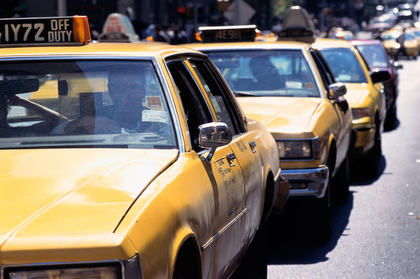
 Cabbies are, as a rule, hard and hungry workers who ply one of the most dangerous jobs in America. |
IT'S beat-up-on-cabbies time in New York City. Some 150 undercover police officers have hit the streets, ready to nail any taxi driver they catch failing to stop for a black passenger or refusing to take passengers to certain neighborhoods. Operation Refusal, the crackdown is called. Operation No Income might be a better name, since a cabbie cited by the city immediately loses, at least for a while, his means of earning a living: His hack license is suspended on the spot, and his vehicle is taken to the nearest police station. Following a hearing, first-time offenders can expect a fine of up to $350; three offenses and the cabbie's license is revoked for good.
Mayor Rudy Giuliani ordered the crackdown after the actor Danny Glover complained that he was repeatedly snubbed by taxi drivers in Manhattan because he is black. Glover didn't doubt that the cabbies who ignored him were motivated by bigotry. Neither did Giuliani and his subalterns. If cabbies "can't see decency on a human level," the taxi commissioner warns, "they will understand it on an economic level." It is not hard to sympathize with Glover, or with any other honest man who has gone through the same infuriating experience. "I don't know of an African-American who has not endured the shame and anger of having a cabdriver lock his doors upon approaching them," writes Floyd Flake, a black former congressman from Queens, in the New York Post. "An additional indignity usually follows: the cracked window and the question about where the rider is headed — and then the driver pulling off, saying he's not headed in that direction."
Flake dubs the practice "transportation apartheid." Others label it "drive-by racism." A New York Times editorial supporting Operation Refusal was titled "Taxi Discrimination."
Are there hate-addled drivers who are so steeped in prejudice that they would rather forgo a fare than let a nonwhite passenger sit in their cab? Possibly. But it's a strange sort of racism that kicks in when a black man hails a cab, only to disappear when the passenger at the curb is a black woman. Stranger still when it affects not only cabbies who are white but those who are themselves dark-skinned.
With his customary swagger, Giuliani brushed off any complaints that the taxi crackdown might provoke. "I know we're going to get the same howls and screams and yells that we got when we did this with drunk drivers," he said, referring to a policy of seizing the cars of people arrested for driving while intoxicated.
The comparison is an insult. Cabbies are not drunk drivers. They are, as a rule, hard and hungry workers who ply one of the most dangerous jobs in America. "Taxicab drivers and chauffeurs face unusually high risks of becoming homicide victims," noted the Bureau of Labor Statistics in a 1994 report. "This occupation accounted for almost one-10th of all victims of job-related homicide but less than one-half of 1 percent of the nation's work force. Nocturnal trips, especially those to secluded areas, make these drivers particularly vulnerable. Almost half the cabdrivers died from 9 p.m. to 3 a.m."
It is a rare cabbie who can afford to pass up ready cash to indulge something as irrational as dumb bigotry. For most, racism isn't a reason to avoid picking up black men or driving to black neighborhoods. Prudence is.
Yes, it is rotten when a black man can't get a taxi to take him home from work. It is unfair. It is cruel. But not as cruel as when a taxi driver gets robbed at gunpoint — or stabbed — or killed — by a passenger.
It is a bitter fact of life that black males in America commit crimes of violence far out of proportion to their numbers. They account for more than 40 percent of those arrested for violent crimes and 56 percent of those arrested for murder. Thirteen percent of black men are convicted felons. In many cities, the percentage is higher. In Washington, D.C. — a city with a black mayor, a majority-black police force, and a great sensitivity to racism — the likelihood that a young black male will be arrested before his 35th birthday is 70 percent.
"There is nothing more painful to me at this stage in my life," lamented Jesse Jackson in 1993, "than to walk down the street and hear footsteps and start thinking about robbery — then look around and see somebody white and feel relieved."
That's not racism; it's reality. And many black Americans share that reality. In a 1996 survey by the Joint Center for Political and Economic Studies, 52 percent of blacks said they were afraid to walk alone at night in their own neighborhoods. A cabdriver need not be a bigot to want to steer clear of those neighborhoods as well.
Operation Refusal and similar crackdowns in other cities will not end this problem. Taxi drivers are not about to start ignoring their instincts or forgetting their priorities. As one black cabbie told The Washington Post a few years ago, "I'd rather be fined than have my wife a widow."
Jeff Jacoby is a columnist for The Boston Globe.
-- ## --
Follow Jeff Jacoby on X (aka Twitter).
Discuss his columns on Facebook.
Want to read something different? Sign up for "Arguable," Jeff Jacoby's free weekly email newsletter.