





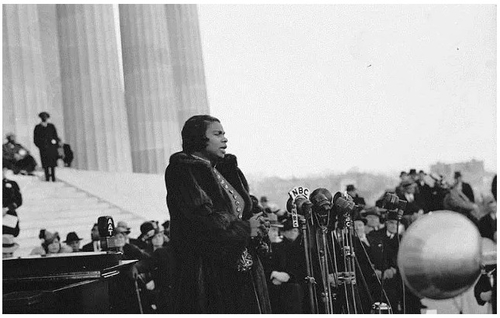
 When the DAR refused permission to Marian Anderson to appear in its Constitution Hall in 1939, the legendary singer performed before the Lincoln Memorial for a vastly greater audience. |
SHE WAS BLESSED with one of the greatest singing voices of her time. At 6, she was a member of the choir in her local church; by 22, she was on concert tours. She defeated 300 competitors in a national contest for an appearance with the New York Philharmonic. For her Metropolitan Opera debut, she sang the role of Ulrica in Verdi's "Un Ballo in Maschera."
But because Marian Anderson was black, the Daughters of the American Revolution barred the legendary contralto from singing in its Constitution Hall in Washington. That well-known, shameful episode took place in 1939. In the nearly 50 years that have elapsed, you'd think the DAR would have mended its ways.
Better think twice.
In a closed session a few weeks ago, the national board of the DAR, led by its president general, Sarah King of Tennessee, voted overwhelmingly to censure two of its New England members for "conduct calculated to disturb the harmony" and "injurious to the good name" of the organization. Joyce Finley of Framingham, Mass., and Faith Tiberio of Sherborn, Mass., thereby became the only Daughters in 60 years to have been so disciplined. (The board later voted to reprimand the two women, but suspended any specific disciplinary measure.)
Their crime? In April 1984, they called a news conference in Washington to publicly denounce a proposed bylaw restricting eligibility for DAR membership to women "legitimately descended" from a Revolutionary War ancestor.
On the surface, the proposal might have seemed like the product of overrefined daintiness, but something more was intended. As Tiberio explained at the time, most blacks in colonial days were barred from entering into legally binding contracts, including marriages. Consequently, she said, "the addition of this tiny word — 'legitimately' — changes the whole basis for membership in the society. The amendment is blatantly calculated to prevent blacks from joining the DAR."
Over at DAR headquarters at 1776 D St. in Washington, those remarks really stung. The Washington Post had been running embarrassing stories about Lena Ferguson, a black descendent of a colonial patriot, who had been trying for years to join her local Washington-area DAR chapter. (My research found only five current DAR members who are black.) President King responded that "being black is not the only reason some people have not been accepted into chapters.... I would say that being black is very far down the line." The two women from New England were only adding to the controversy.
The DAR wasted no time. Within days, a list of charges was drawn up, accusing Finley and Tiberio of attempting to "defame, humiliate, and destroy" King and her officers. And so — though it may have taken 18 months to do it — an organization chartered by Congress "to act in securing for mankind the blessing of liberty" has now succeeded in reprimanding two members for exercising free speech in the defense of equality.
To the Daughters of the American Revolution, which condemned Theodore Dreiser's 1925 novel "An American Tragedy" as a dangerous book for its critique of wealth, privilege, and blind patriotism, nothing is more sacred than tradition. And racial bigotry is as longstanding a DAR tradition as the annual White House tea and the wearing of orchid corsages.
For what happened to Marian Anderson had happened earlier to other black performers. It happened to Roland Hayes, the renowned Boston concert tenor. It happened to Paul Robeson. It happened to the great Eddie Condon jazz band.
When it happened in 1945 to Hazel Scott, the bride of Representative Adam Clayton Powell Jr. of New York, President Truman compared the DAR's "whites-only" policy to Nazism. Connecticut Representative Clare Boothe Luce — herself a Daughter — pleaded in a nationwide radio broadcast for the elimination of the anti-black rule. Luce launched a "DAR Committee Against Racial Discrimination" that directed a steady drumbeat of criticism at the DAR's national board.
"In your deep concern for white faces," she declared in an acid rebuke, "you are paradoxically enough giving our DAR a couple of black eyes."
To no avail. The policy was reaffirmed, and Rep. Luce resigned from the DAR the following year in disgust, along with other Daughters, including the late Frances Bolton of Ohio, another Republican member of Congress.
As they left, Luce and her followers were savagely criticized by the DAR leadership, but those black eyes smarted for a long time. So long, in fact, that the organization was still seeking to make amends 40 years later.
In early 1984, King bestowed a special DAR award to none other than Clare Boothe Luce.
When asked about racism in the organization she leads, King employs this analogy: "If you give a dinner party and someone you don't want insists on coming, what would you do?"
Luce accepted the DAR award before the harassment of Joyce Finley and Faith Tiberio occurred. Today, she would no doubt spurn it for its ugly hypocrisy, holding fast to the integrity she demonstrated so admirably four decades ago — an integrity that still has power to inspire, and that honors the Revolutionary ideals the DAR has done so much to disgrace.
Jeff Jacoby is a lawyer, political consultant, and free-lance writer in Boston. A version of this column first appeared in the Lowell (Mass.) Sun.
-- ## --