






FOR YEARS anti-Israel agitators have urged consumers and institutions to support the international hate campaign against the world's only Jewish country by boycotting Israeli products, services, and individuals. Some organizations even provide lists of goods or companies for their followers to shun when buying groceries, housewares, or toys.
But those lists are woefully incomplete. For example, the Ireland Palestine Solidarity Campaign publishes "A Quick Guide to Help Boycott Israeli Goods" that red-flags, among other things, Israeli-grown oranges and dates, Israeli-manufactured SodaStream sparkling water makers, Israel-based Ahava cosmetics and skin care products, and made-in-Israel Stanley toolboxes and organizers.
If you imagine that buying dates grown in Egypt instead of Israel will somehow make the world a better place or benefit Palestinians, I won't try to talk you out of it. If, like Germans in the 1930s, you believe that refusing to do business with Jewish vendors is a mark of your moral earnestness, don't let me get in your way.

But if you're going to boycott Israel and Israelis, surely you don't want to limit yourself to minor gestures like switching from one brand of hand lotion to another. If you're serious about purging yourself of any economic connection to the land and people of Israel, then there are a lot of other products you should be steering clear of. In a YouTube video, journalists Yoseph Haddad and Emily Schrader highlight some of them.
For instance, they note, no committed boycotter of Israel should be driving an electric car, since it was the Israeli firm StoreDot — and before that, Better Place — that pioneered the technologies and batteries used today for electric cars around the world. Nor should anyone who is determined to avoid Israeli companies rely on Waze for driving directions, since the app was founded by Israeli entrepreneurs.
 If you're serious about boycotting Israel, you'd better avoid using computers, flash drives, and sending email. |
Email, too, is something no committed Israel-boycotter should make use of, since the algorithm underlying most email traffic was developed by Israeli researchers at Ben-Gurion University in Beersheba in 1980. So was the technology that makes possible antivirus protections — some of which were perfected at Microsoft's R&D center in Herzliya.
Frankly, it might be better to avoid using personal computers altogether, since so many of them use Intel Pentium or Celeron processor chips, which have long been produced in — yep — Israel. Even a USB thumb drive or memory stick is something no self-respecting enemy of Israel should purchase. That's because it was invented by Dov Moran, who served in the Israeli Navy for seven years before launching M-Systems, which in 1999 filed the first patent for a USB flash drive.
Haddad and Schrader helpfully remind their viewers that Israel is a renowned center for medical innovations, from flexible coronary stents used in combating heart disease to groundbreaking treatments for blood cancers. Moreover, they note, drip irrigation technology that Israel pioneered in the 1960s has "helped provide water for communities and farming for millions of people around the world." An Israeli firm, Netafim, is the global leader in drip- and micro-irrigation systems and has expanded agricultural output in numerous countries, including India, Rwanda, and Ethiopia.
Of course those are only some of the innovations, improvements, and breakthroughs for which Israeli researchers and companies can take credit. Not for nothing has Israel been dubbed the "Start-up Nation" — indeed, there are more startups per capita in Tel Aviv than anywhere else in the world outside of Silicon Valley. Israel has a population of just 9 million and is smaller in area than New Jersey, but it plays a key role in supplying the goods and services on the cutting edge of 21st-century progress. Enemies of the Jewish state are, of course, free to call for boycotting or divesting from Israel. But if they mean what they say, they ought to put their money and their lifestyle where their mouths are. Let them avoid everything that Israel contributes to their comfort, welfare, and technology. True, their lives will be impoverished. But they'll be true to their antisemitism.
* * * * * * * * * * * * * * * * * * * * * * * * * * * * * * * * * * * * * * * * * * * * * * *
Just say no to more mass transit
For most urban planners, it is an article of faith that mass transit is not only good but essential — and that more mass transit should be a priority. Total funding on public transit in 2022 (the most recent data available) soared past $84 billion nationwide, an increase of nearly $5.5 billion since 2019. Under the Biden administration, the Federal Transit Administration last year approved $21 billion in new federal subsidies to agencies around the country, touting it as a "record investment in American transit."
Yet no matter how much is spent on public transportation, we are constantly hectored that more is needed. In her State of the Commonwealth address to the Legislature earlier this year, Governor Maura Healey called for doubling the amount spent on the MBTA, in addition to reducing fares for low-income riders, which would add another $45 million to the cost of operating the T's bus and subway lines. On Beacon Hill, in City Hall, and in much of the media, it is taken for granted that public transit is indispensable.
"Getting people out of their cars and onto trains isn't just an economic necessity. It's also an environmental imperative," one Boston Globe colleague wrote in 2022. "Transportation accounts for the bulk of the state's greenhouse gas emissions." Hence the neverending push to extend subway and bus lines — or, even more ambitious, to undertake a "massive expansion" of public transit in Greater Boston.
All of which may seem reasonable to those for whom public transportation is always good and automobiles are always bad, regardless of changes on the ground. But in the real world, the glaring truth about public transit is that fewer and fewer Americans want anything to do with it.
As longtime transportation analyst Wendell Cox documented recently for the Committee to Unleash Prosperity, the share of commuters riding on public transit in the nation's largest metropolitan areas has in virtually every case plummeted since 1960 — and the decline has accelerated since the COVID-19 epidemic. The numbers in Boston are typical. In 1960, public transit accounted for fully 25 percent of commutes in Greater Boston. By 2019 (pre-pandemic), that share had fallen to 13 percent. As of 2022, it was only about 7 percent. In the other metro areas Cox analyzed, the same pattern prevailed. Only in New York does a significant share of commuters use public transportation. Everywhere else, mass transit amounts to little more than a niche means of getting to work.
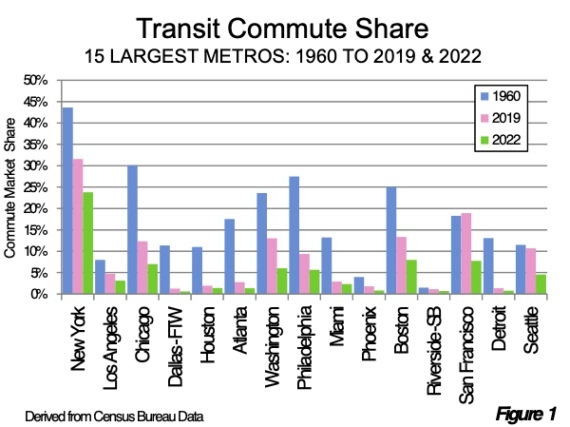 Public transit in Boston and elsewhere held little appeal for the vast majority of working people even pre-pandemic. Now their interest has shrunk further. |
Last week I called Cox, who heads the Demographia policy firm, to explore the numbers and their implications in more detail. He didn't pull any punches. He marveled at what he called "the absolute delusion of planners" in Boston and elsewhere, who still haven't grasped that COVID-19 caused a permanent revolution in remote work. Since 2019, the number of Americans who generally work from home has skyrocketed by 172 percent, he said. That has led to a massive decrease in both the number of people driving to work and the number using public transportation to commute.
Working with Census Bureau data from the American Community Survey, Cox has crunched the numbers for the eight cities with the largest downtown business districts — Boston, Chicago, Los Angeles, New York, Philadelphia, San Francisco, Seattle, and Washington, D.C. In every case, the number of people who report working in the city dropped between 2019 and 2022. As a result, so has the number of people getting to work in cars and those getting to work via transit.
Boston's experience is typical. According to Cox, the most recent census statistics show that 108,000 fewer people work in the city now than before the pandemic, 31,000 fewer workers are driving into Boston for work, and 115,000 fewer workers are commuting by T. In the broader metropolitan area outside the borders of Boston, by contrast, the number of people working is up by 56,000. Yet so entrenched has working from home become that close to half a million more people no longer commute — between 2019 and 2022, car rides to the job dropped by 423,000 and public transit commutes by 39,000.
Remote work is here to stay. Cox, citing figures by WFH Research, says that work from home amounted to 7.2 percent of work hours on March 1, 2020, just before the pandemic struck the US economy. Four years later, just under 29 percent of all work hours occur at home — a fourfold increase.
Public transit in Boston and pretty much everywhere else (again, New York is the exception), held little appeal for the vast majority of working people even pre-pandemic. Now their interest has shrunk still further. It is not more urgent than ever that the T be subsidized and expanded, it is less so.
COVID-19 was a terrible tragedy. It caused enormous harm and led to much grief. But it had at least these two silver linings: First, a vast number of Americans have stopped driving to work, with a commensurate effect on carbon emissions. And second, the plunge in transit use makes it clearer than ever that the "need" to expand public transportation is nonexistent. It makes no sense to pump billions of additional dollars into more mass transit that commuters won't use. Environmentalists ought to take the win, celebrate the reduction in car commuting, and move on to other priorities.
* * * * * * * * * * * * * * * * * * * * * * * * * * * * * * * * * * * * * * * * * * * * * * *
The Last Line
"His hands lift of their own and he feels the wind on his ears even before, his heels hitting heavily on the pavement at first but with an effortless gathering out of a kind of sweet panic growing lighter and quicker and quieter, he runs. Ah: runs. Runs." — John Updike, Rabbit, Run (1960)
+++++++++++++++++++++++++++++++++++++++++++++++++++++++++++