



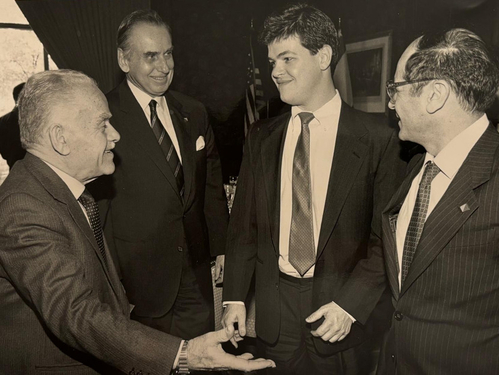
 Israeli Prime Minister Yitzhak Shamir, in Boston for two days, expressed surprise upon meeting Jeff Jacoby, 32, the chief editorial writer of the Boston Herald. "I heard about this young man," the 76-year-old Shamir said, "but I didn't know he was SO young." Also in attendance were Zalman Shoval, Israel's ambassador to Washington (2nd from left) and Yaakov Levy, the Israeli consul general to New England. |
IN A move aimed at getting the Mideast peace talks back on track, Israel's Prime Minister Yitzhak Shamir disclosed yesterday he is willing to compromise on the site for the second phase of discussions.
The prime minister, in Boston for a two-day visit, said he will suggest to President Bush during their meeting Friday that the talks resume in Cyprus, which Shamir prefers over Washington as a compromise site.
Israel has pushed for the next round of bilateral talks with the Syrian, Jordanian-Palestinian and Lebanese delegations to be held in the Middle East, but Shamir yesterday signaled a willingness to compromise.
During a 90-minute interview at a luncheon at the Four Seasons Hotel hosted by the Herald, Shamir declared: "We are ready to propose ... that we make it near there (the Middle East). Places like Cyprus or similar places are better for us."
Arab states, hoping to use international pressure against Israel, want the peace talks to be held away from the Mideast to avoid the appearance of accepting Israel's legitimacy as a nation.
The prime minister said he disliked Washington as a location for the talks because it would leave negotiators too far from Israeli leaders.
"It's very difficult to do it by remote control," Shamir said. "It will not be efficient. It will not be serious. It will prolong the negotiations."
But Shamir did not rule out Washington as a site for the talks, which one source close to the Israeli leader predicted could begin as early as the week following Thanksgiving.
Shamir, 76, arrived in Boston early yesterday as part of a 10-day visit to the United States. He stops in Baltimore tomorrow before meeting with Bush Friday.
Shamir, the first Israeli prime minister to visit the Hub in 31 years, will make a major address today at Boston University and receive an honorary degree.
During the wide-ranging interview with Herald editors, reporters and executives of News Corp., including Chairman Rupert Murdoch, Shamir also:
Stressed that Israel was in dire need of $10 billion in loan guarantees to help handle a massive influx of Soviet immigrants. Bush is withholding the monies at least until next year, pending signs of progress in the Mideast peace process.
"We need this money," said Shamir. "Maybe the president has some suggestions."
Expressed frustration that the Gulf war did not result in the elimination of Iraq's nuclear capability.
"We are sad about it, we regret it very much," said Shamir. "Now it is a very critical question, a very crucial issue. ... I am not sure that enough thought has been given to this problem." Shamir said he may raise the issue with Bush Friday.
Declined any comment on the recent hostage releases. An aide, however, expressed frustration that the plight of Israeli POWs and MIAs have not been taken "into consideration" more.
Shamir insisted he remained hopeful the parties to the Mideast peace talks could achieve some measure of success.
"There are chances to succeed," Shamir said, but cautioned: "Of course, if the Arabs think that we are coming to the talks with blank generosity to give up all that we have, they will be frustrated."
Shamir held out more hope for an accord with Jordan than with Syria, which he labeled the "most extreme country" among Israel's neighbors.
He said Syria's attitude in Madrid "was not very encouraging. But it seems the Syrians are not willing to leave the process. They want to be inside for their own interests."
But, he added: "When the issue is peace, we have to try. We have to try. Even if reason says it's quite impossible."
Shamir noted Israel and Jordan have common interests such as water, economics, fighting terrorism and border security.
"We have to make formal peace," he said. "I don't see any difficulty in it. After all, there is not much that separates us from Jordan. There are no territorial problems in our opinion."
Jordan, in 1988, renounced its claim on the West Bank, which Israel seized during the 1967 War - with the idea that it could then be used to establish a Palestinian state, something Shamir rejected again yesterday.
He warned that Palestinians can expect nothing more than limited autonomy within the Israeli state. Shamir said: "They have no better choice."
Shamir said he was not impressed by the kinder, gentler image projected by moderate, business-suited Palestinians who attended the Madrid conference - as opposed to the more radical image of Yasser Arafat in a black and white kaffiyeh.
"You certainly know the difference between image and substance," he said. "The Arabs in general and the Palestinians, they are experts in creating images. But there is always a gap between the image and the real substance."
Shamir, reiterating the hard-line stance that has become his political trademark, warned there could be no Palestinian state in the region.
"Everybody knows they want to establish, in our country, a Palestinian state. We will never accept it. We will never allow it. It is a mortal danger to our existence. It doesn't make any sense.
"We will have to mobilize our efforts in order to explain to the world media that it's impossible.
"First of all, it is nonsense to establish an independent state on such a small place. It's laughable. It's ridiculous. It will never work.
"And secondly, it's unjust. Palestine ... it's a geographical name. It's not a historical name. There was never a country called Palestine."
Shamir said, however, Israel will talk about autonomy or "self-government," for the Palestinians.
"We are willing to negotiate about the powers and the limits of this autonomy. But this autonomy is part of an existing sovereign state - and this state will be the state of Israel.
"I think from their point of view they have to accept it. And for us it is also a risk. A risk we take for a peaceful solution. But sometimes we have to take some risks for peace."
Shamir noted Bush's stance on loan guarantees was a departure from the approach favored by former President Carter, who never linked aid to Israel with political concerns.
The issue of loan guarantees has shaken Israel. Bush in September said he would not approve Israel's request for $100 billion to give housing and jobs to the more than 300,000 Soviet immigrants who have come to Israel over the past two years.
Bush has used the loan guarantees as a prod, making it clear he hopes to see progress in the peace process before he grants the monies.
"This was all the time a principle in our relations with the United States," said Shamir. 'We cannot change our position. But we are not the givers, we are the takers."
Jeff Jacoby is a columnist for The Boston Globe.
-- ## --
Follow Jeff Jacoby on X.
Discuss his columns on Facebook.
Want to read something different? Sign up for "Arguable," Jeff Jacoby's free weekly newsletter.